Internal knowledge assistants
Help teams find procedures and policies while respecting the permissions on the underlying material.
What you getPermission-aware retrieval and inspectable source references.

RAG & knowledge search development
Retrieval-augmented generation connects AI answers to the documents your team trusts. Build search and assistance around source quality, access permissions and answers people can check.
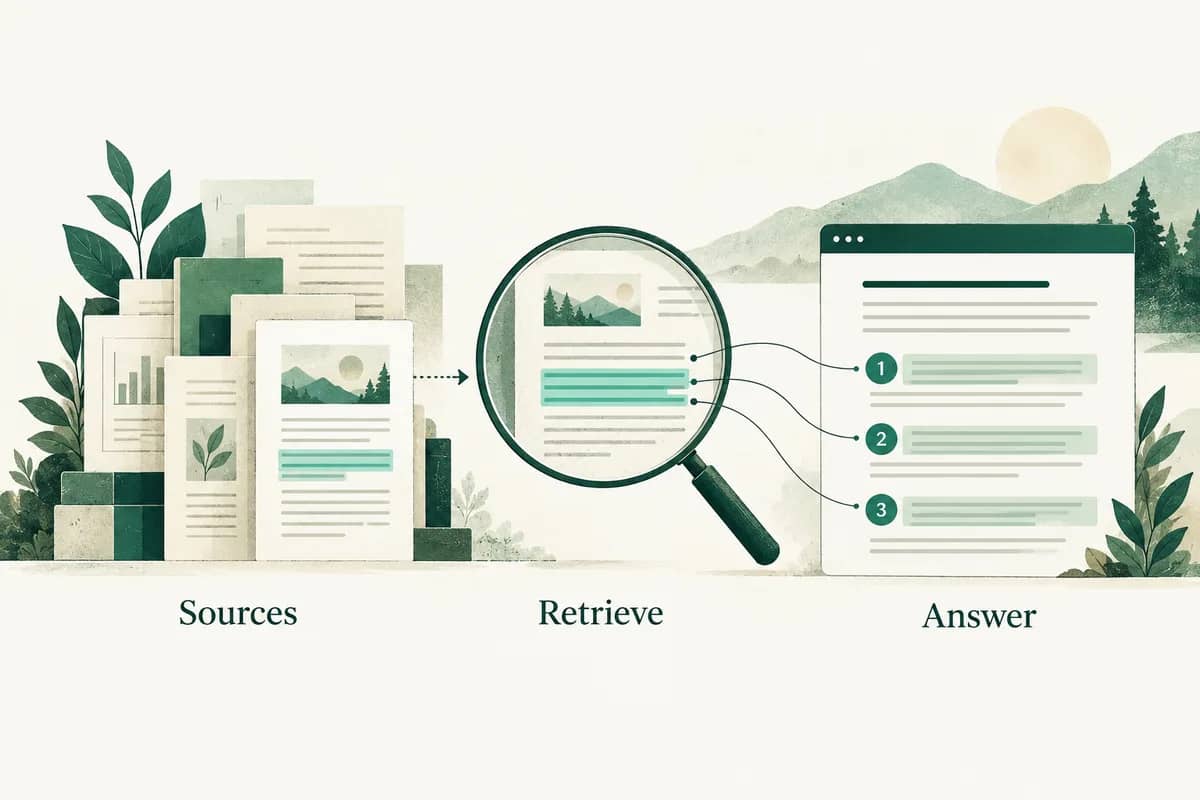
Choose with context
Useful when people need answers from changing policies, product documentation or internal knowledge that a model cannot reliably know on its own.
Retrieval cannot repair missing or contradictory source material. Citation links help users verify answers; they do not automatically make an answer correct.
What we can build
What evidence is needed for a damaged delivery?
Search permitted documents
Use the current policy version
Link the supporting passage
Help teams find procedures and policies while respecting the permissions on the underlying material.
What you getPermission-aware retrieval and inspectable source references.
Search approved product documentation and help articles, with clear escalation when a question needs account-specific investigation.
What you getA curated knowledge set, feedback loop and unanswered-question review.
Combine exact keyword matching and semantic similarity where each contributes to relevant results.
What you getA retrieval benchmark with representative questions and expected sources.
An example architecture
Evaluate retrieval separately from answer quality. Test document updates and deletions as carefully as the first import, and retain source identifiers throughout the pipeline.
Adapted to your systems, data and operating requirements during discovery.
From first scope to handover
We define the first useful release and its acceptance criteria together. Working software, deployment instructions and the decisions behind it stay with your team.
Not always. PostgreSQL with pgvector can be a practical starting point when your operational constraints and retrieval needs fit it. Larger or specialized workloads may justify a dedicated system.
They address different needs. Retrieval supplies relevant source material at request time. Fine-tuning changes model behavior. We first identify whether the failure comes from missing knowledge, retrieval or the task itself.
A new build, an existing codebase or one stubborn problem. Bring the context you have.
A little closer, wherever you are
Product engineering, AI and Odoo ERP, with a shared plan and a working rhythm built around your team.
Different time zones. One shared conversation.
Explore our global presence