
Make releases repeatable. Make operations understandable.
Cloud architecture, delivery automation and reliability work tied to your workloads, operating team and actual cost drivers.
Clear scopeReviewable deliveryPlanned handover
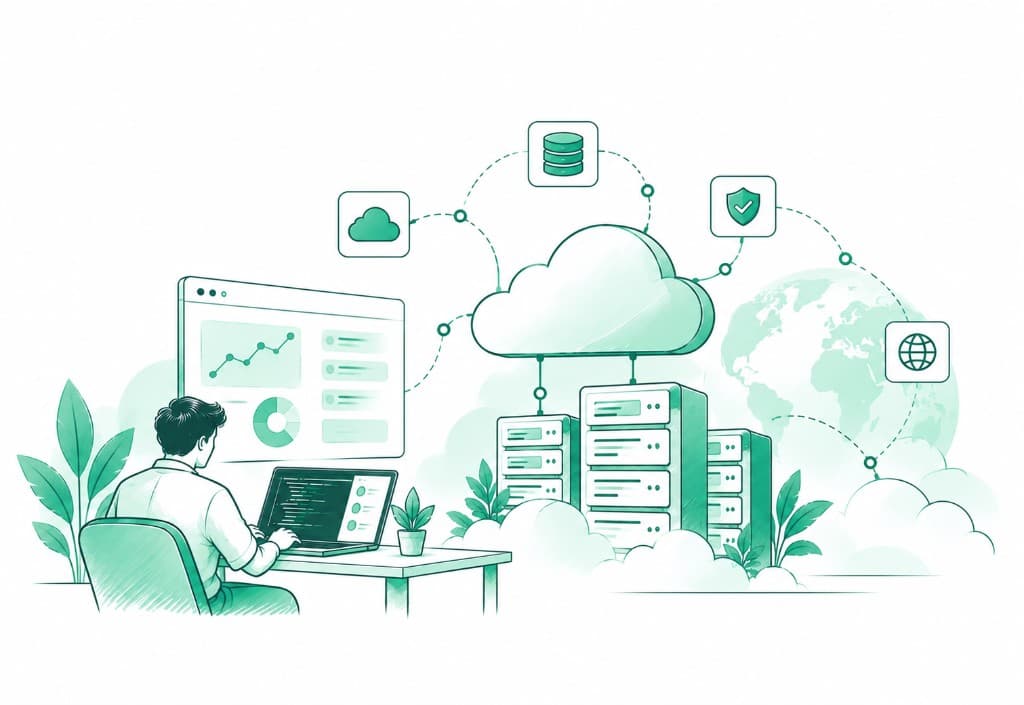
Start with the reason
Is this the work you need next?
Infrastructure is useful when a team can change it, observe it and recover it. We start with workload requirements and operational ownership before choosing more services.
Cloud spend is growing without clear workload ownership
A migration or reliability improvement needs a controlled plan
A useful starting scope pairs one of these needs with an accountable owner and a way to review the result.
The engagement, made tangible
Know what you are investing in.
Open a workstream to see its outputs. The proposal defines which artifacts and implementation work belong in your engagement.
Workstream 01
Workload assessment
Understand dependencies, capacity and operational constraints.
- Current-state inventory
- Availability and recovery requirements
- Prioritized improvement plan
Bring this into your briefDiscuss this workstream
Choose with the trade-offs visible
There is more than one way forward.
A sound recommendation depends on your constraints. The choice is explicit before it becomes an implementation assumption.
Improve in place
Consider this when the current provider and architecture still suit the workload.
What to weigh
Start with deployment, observability or cost attribution gaps.
Migrate a bounded workload
Consider this when the destination has a clear operating or commercial advantage.
What to weigh
Plan dependency testing, cutover and rollback before migration.
See the whole engagement
The handoffs matter as much as the build.
Before implementation, identify the decisions, systems, and owners at each boundary. This map is a discussion framework, refined around your environment.
- 01
Source and build
- 02
Environment and access
- 03
Deployment and runtime
- 04
Observe and recover
How the work progresses
A decision at every milestone.
Use working evidence to review progress. Dates are agreed after scope and dependencies are understood.
Define
Agree on the problem, users, and constraints.
Decision evidence
An approved scope and acceptance criteria
Make tangible
Review the experience, contracts, or operating model.
Decision evidence
A reviewed design and dependency plan
Build and review
Implement in increments with visible progress.
Decision evidence
Working outputs checked against the scope
Release and transfer
Prepare operation, adoption, and ownership.
Decision evidence
Release approval and agreed handover assets
Quality and business value
Two questions before you call it done.
Does it behave as agreed, and is it creating the change you intended? Review both with evidence appropriate to the service.
Delivery evidence
Is the work ready?
Pipeline and rollback rehearsal
Backup restoration exercise
Load, alert and access review
Value signals
Is the change useful?
Deployment failure rate
Recovery time in agreed exercises
Cloud cost per useful workload unit
Agree on definitions, a baseline, and a review period. These are suggested measures, not promised results.Designed for continuity
Plan the handover before the handover.
Ownership should be understandable throughout the engagement. Record the assets, access, and responsibilities your team needs after delivery.
Explore how we workProject assets
Identify source, designs, configuration, and documentation in the agreement.
Accounts and environments
Agree on account ownership, access roles, and credential handover.
Operational knowledge
Document routine tasks, recovery steps, and known limitations.
Ongoing responsibility
Define what your team owns and what support remains in scope.
Make the commercial conversation useful
What shapes the investment?
A credible estimate follows the work. These are the factors we clarify before proposing scope and delivery commitments.
01
Workload dependencies
Confirm during scoping02
Availability and recovery requirements
Confirm during scoping03
Environment count and operating coverage
Confirm during scopingBring a current system overview, representative workflows, and any fixed constraints. We can identify where discovery is needed and where a build can be estimated directly.
Request a scoped estimateHow we work together
Choose ownership, then the team.
Agree on who prioritizes work, reviews decisions, and accepts delivery. The engagement model follows that responsibility.
A defined engagement
For a bounded piece of work with clear outputs.
Agree on milestones, dependencies, and change handling.An ongoing product team
For a product or platform with a continuing roadmap.
Maintain shared priorities, review cadence, and release ownership.Embedded capability
For teams that already lead delivery and need additional expertise.
Align contributors to your engineering standards and review practices.Evaluate the people behind the promise
Bring the same scrutiny to your delivery partner.
Review published work, then ask us to connect relevant experience to your scope, constraints, and expected outcomes.
Connected work
Bring the right capabilities together.
Engineering & operations
API development
API design, implementation and system integration with clear consumer expectations, access boundaries and operational visibility.
See this service
Engineering & operationsHire developers
Dedicated engineers and squads who join a team that already owns the roadmap.
See this service
Before you decide
Clear answers. A better brief.
Which cloud platforms does PySquad work with?
AWS, Microsoft Azure, and Google Cloud Platform, including architecture design, landing zones, migration, Kubernetes, serverless, and cost optimization.
Do you provide DevOps and CI/CD setup?
Yes. Pipelines, infrastructure as code, environment promotion, secrets management, and observability so releases are repeatable and rollback-safe.
Can you migrate our workloads to the cloud?
Yes. We assess applications, plan phased migration (rehost, refactor, or rebuild), run parallel testing, and manage cutover with minimal downtime.
How do you handle security and compliance in the cloud?
Identity and access management, network segmentation, encryption, logging, backup policies, and alignment with your compliance framework (SOC 2, HIPAA-ready patterns, etc.).
Do you offer ongoing cloud operations support?
Yes. We provide monitoring, incident response, patching, scaling, and FinOps reviews on retainer or alongside product engineering teams.
How do we start a cloud engagement?
Share your current hosting model and goals (migrate, scale, or reduce cost). We audit, recommend architecture, and propose a phased execution plan with clear owners.
Your next move
Define the work worth doing.
Choose where you are and what to discuss. We carry that into the enquiry for Cloud & DevOps.