
Give every integration a contract it can rely on.
API design, implementation and system integration with clear consumer expectations, access boundaries and operational visibility.
Clear scopeReviewable deliveryPlanned handover
Start with the reason
Is this the work you need next?
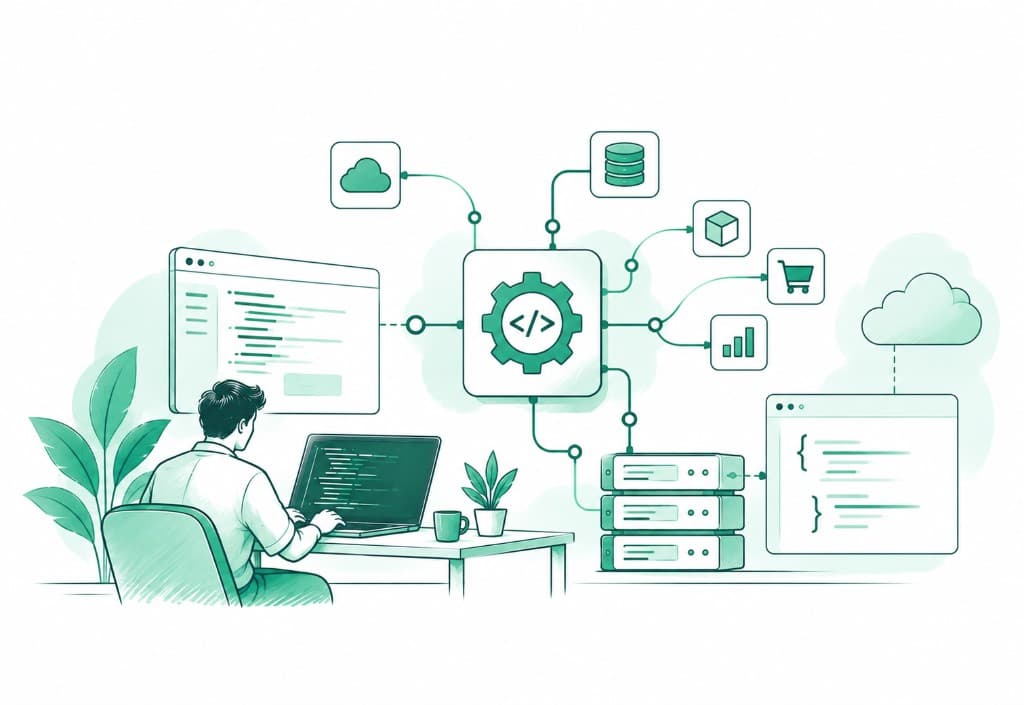
An API is an agreement between teams. Its value comes from predictable behavior when requests are valid, incomplete, repeated or interrupted.
Internal systems exchange data through fragile manual steps
Existing APIs lack clear contracts or failure visibility
A useful starting scope pairs one of these needs with an accountable owner and a way to review the result.
The engagement, made tangible
Know what you are investing in.
Open a workstream to see its outputs. The proposal defines which artifacts and implementation work belong in your engagement.
Workstream 01
Contract design
Define what consumers can send, receive and safely rely on.
- Resource and operation definitions
- Examples and error responses
- Versioning decisions
Bring this into your briefDiscuss this workstream
Choose with the trade-offs visible
There is more than one way forward.
A sound recommendation depends on your constraints. The choice is explicit before it becomes an implementation assumption.
Direct synchronous API
Consider this when the consumer needs an immediate response and dependencies can support it.
What to weigh
Define timeouts and failure behavior for each downstream call.
Event-driven exchange
Consider this when systems can act independently and tolerate delayed updates.
What to weigh
Define ordering, duplicate handling and reconciliation explicitly.
See the whole engagement
The handoffs matter as much as the build.
Before implementation, identify the decisions, systems, and owners at each boundary. This map is a discussion framework, refined around your environment.
- 01
Consumer contract
- 02
Access and validation
- 03
Business operation
- 04
Records and event delivery
How the work progresses
A decision at every milestone.
Use working evidence to review progress. Dates are agreed after scope and dependencies are understood.
Define
Agree on the problem, users, and constraints.
Decision evidence
An approved scope and acceptance criteria
Make tangible
Review the experience, contracts, or operating model.
Decision evidence
A reviewed design and dependency plan
Build and review
Implement in increments with visible progress.
Decision evidence
Working outputs checked against the scope
Release and transfer
Prepare operation, adoption, and ownership.
Decision evidence
Release approval and agreed handover assets
Quality and business value
Two questions before you call it done.
Does it behave as agreed, and is it creating the change you intended? Review both with evidence appropriate to the service.
Delivery evidence
Is the work ready?
Contract and compatibility tests
Authorization and duplicate-request tests
Timeout, retry and failed-delivery checks
Value signals
Is the change useful?
Integration error rate
Latency for agreed operations
Time to onboard a new consumer
Agree on definitions, a baseline, and a review period. These are suggested measures, not promised results.Designed for continuity
Plan the handover before the handover.
Ownership should be understandable throughout the engagement. Record the assets, access, and responsibilities your team needs after delivery.
Explore how we workProject assets
Identify source, designs, configuration, and documentation in the agreement.
Accounts and environments
Agree on account ownership, access roles, and credential handover.
Operational knowledge
Document routine tasks, recovery steps, and known limitations.
Ongoing responsibility
Define what your team owns and what support remains in scope.
Make the commercial conversation useful
What shapes the investment?
A credible estimate follows the work. These are the factors we clarify before proposing scope and delivery commitments.
01
Number of consumers and operations
Confirm during scoping02
Partner API limitations
Confirm during scoping03
Consistency and migration requirements
Confirm during scopingBring a current system overview, representative workflows, and any fixed constraints. We can identify where discovery is needed and where a build can be estimated directly.
Request a scoped estimateHow we work together
Choose ownership, then the team.
Agree on who prioritizes work, reviews decisions, and accepts delivery. The engagement model follows that responsibility.
A defined engagement
For a bounded piece of work with clear outputs.
Agree on milestones, dependencies, and change handling.An ongoing product team
For a product or platform with a continuing roadmap.
Maintain shared priorities, review cadence, and release ownership.Embedded capability
For teams that already lead delivery and need additional expertise.
Align contributors to your engineering standards and review practices.Evaluate the people behind the promise
Bring the same scrutiny to your delivery partner.
Review published work, then ask us to connect relevant experience to your scope, constraints, and expected outcomes.
Connected work
Bring the right capabilities together.
Engineering & operations
Cloud & DevOps
Cloud architecture, delivery automation and reliability work tied to your workloads, operating team and actual cost drivers.
See this service
Engineering & operationsHire developers
Dedicated engineers and squads who join a team that already owns the roadmap.
See this service
Before you decide
Clear answers. A better brief.
What API services does PySquad offer?
API strategy, REST and event-driven design, implementation, versioning, documentation, security, rate limiting, and integrations between products, ERP, payment, and partner systems.
Which technologies do you use for APIs?
Python (Django, FastAPI), Node where it fits, PostgreSQL and Redis, OpenAPI specs, and cloud-native deployment with logging, metrics, and tracing for production support.
Can you design APIs for mobile apps and third-party partners?
Yes. We define auth models (OAuth2, API keys, JWT), pagination, idempotency, webhooks, and sandbox environments so partners and mobile clients integrate predictably.
How do you handle legacy system integration?
We map entities and events, choose sync vs async patterns, add retries and dead-letter handling, and document contracts so operations teams can monitor and support integrations long term.
Do you provide API documentation and developer experience?
Yes. OpenAPI/Swagger, examples, changelog discipline, and optional SDK guidance so internal and external developers can adopt APIs without constant engineering support.
How do we begin an API development engagement?
Share your systems diagram and integration goals. We run a short discovery, propose architecture and milestones, and start with the highest-risk integration or core domain API first.
Your next move
Define the work worth doing.
Choose where you are and what to discuss. We carry that into the enquiry for API development.