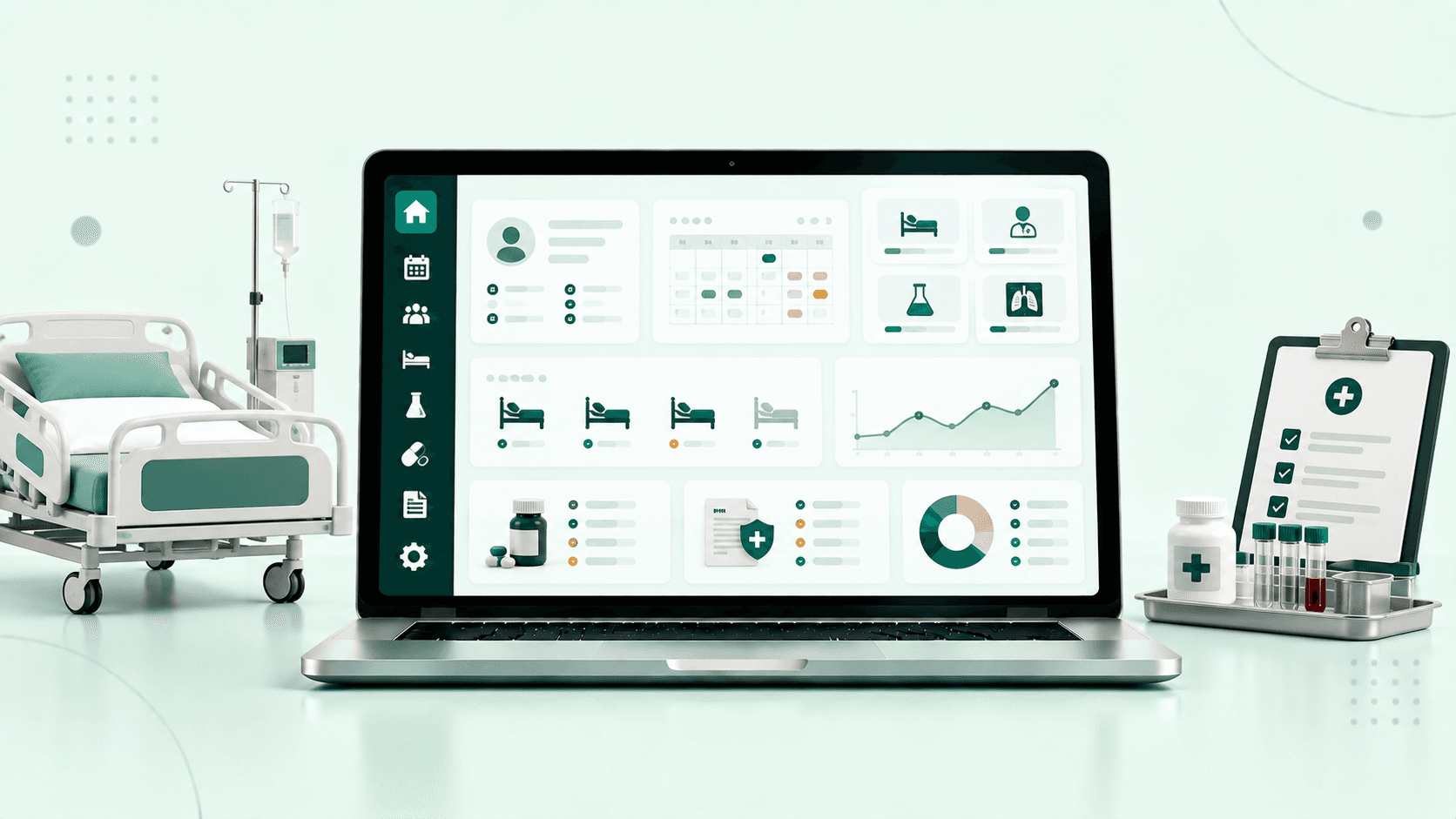
Replace fragmented hospital software with an Odoo Hospital Management System that connects EMR, admissions, pharmacy, labs, billing, insurance, and finance in one platform.
Better coordination between clinical and administrative departments
More accurate billing, insurance processing, and financial reporting
Faster patient movement across OPD, IPD, diagnostics, and discharge
Improved operational visibility through real time dashboards and reporting
Results depend on scope, integrations and adoption.
The operating context
A clearer view of the whole operation.
Hospitals need clinical, operational, and financial workflows to work from the same data. Odoo can connect patient records, diagnostics, pharmacy, admissions, billing, procurement, and accounting across departments and facilities.
Where friction builds
Disconnected hospital systems create delays long before patients notice them.
Hospitals often rely on separate applications for admissions, laboratory services, pharmacy, billing, and insurance. Staff repeatedly enter the same patient information, while departments depend on phone calls or manual updates to coordinate care.
The result is slower patient flow, inconsistent clinical records, billing disputes, delayed insurance approvals, and limited visibility into occupancy, revenue, and operational performance.
Current approach
Using separate systems for clinical and administrative operations
Maintaining patient records across disconnected tools
Patient information becomes inconsistent across departments
Clinical decisions slow when records are incomplete
Billing discrepancies create revenue leakage
Management lacks real-time operational visibility
Inside the solution
The capabilities behind the operation.
Review the functional scope, then discuss the requirements specific to your team.
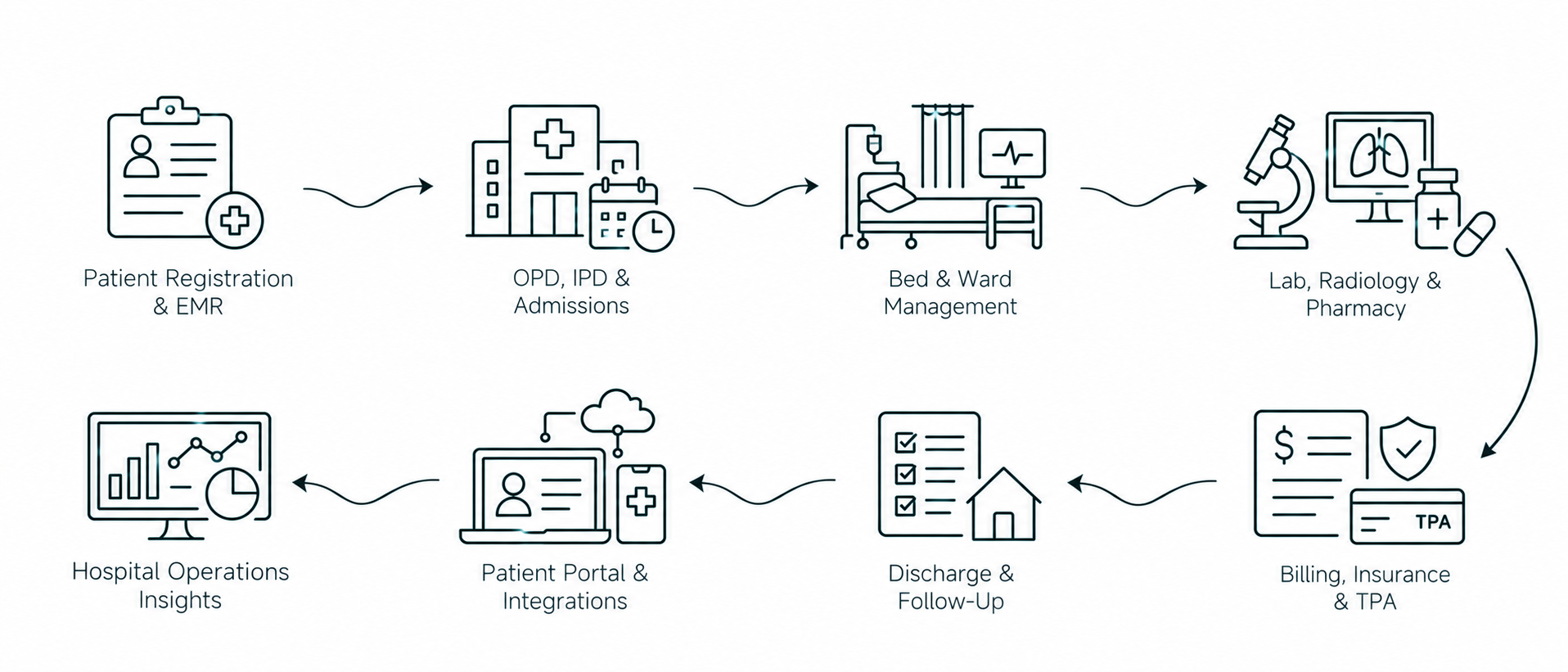
Centralized EMR and Patient Record Management
Maintain a single patient record with consultations, diagnoses, medications, allergies, clinical history, investigations, and treatment plans accessible through controlled user permissions.
Integrated OPD, IPD, and Patient Journey
Manage appointments, admissions, transfers, discharge, follow up care, and patient movement through standardized workflows that reduce manual coordination.
Ward, Bed, and Resource Management
Monitor bed availability, room allocation, occupancy, nursing stations, and patient transfers in real time to improve capacity planning.
Laboratory, Radiology, and Pharmacy Integration
Create digital orders, track sample status, manage prescriptions, connect inventory, and record diagnostic results within the patient's medical record.
Billing, Insurance, and TPA Management
Support package billing, service charges, consumables, insurance pre authorization, claim tracking, and financial reconciliation from a single workflow.
Analytics, Patient Portal, and Healthcare Integrations
Provide dashboards for hospital management, secure patient access to reports and invoices, and integrate with accounting, CRM, HRMS, business intelligence, and healthcare interoperability standards.
Document clinical, financial, and administrative workflows before configuration
02
Configure department specific processes instead of relying on generic templates
03
Integrate EMR, inventory, accounting, pharmacy, laboratory, and patient billing
04
Plan data migration with validation of historical patient records
05
Implement role based access, audit trails, and compliance focused permissions
06
Train hospital teams using real patient scenarios before production deployment
Our approach
We begin every implementation by mapping actual hospital workflows instead of forcing hospitals to adapt to standard software. Clinical processes, administrative operations, financial controls, and regulatory requirements are configured within Odoo using role based access, approval rules, and department specific workflows. We also plan integrations with laboratory equipment, accounting, HRMS, patient portals, and external healthcare systems where interoperability through HL7 or FHIR is required.
How it connects
The complete workflow, in one view.
Make an informed decision
Is this the right fit?
The right solution starts with the right operating requirements.
An Odoo Hospital Management System is an ERP solution that connects patient records, clinical workflows, hospital administration, billing, pharmacy, laboratory, and financial operations in one platform. Unlike standalone hospital software, it allows departments to share the same data, reducing duplicate work and improving coordination throughout the patient journey.
Can Odoo integrate with existing EMR systems, laboratory equipment, or healthcare applications?
Yes. Odoo can integrate with existing healthcare systems through APIs, HL7, FHIR, or custom interfaces, depending on the software and equipment already in use. During implementation, integration requirements are assessed early to avoid duplicate patient records and maintain consistent clinical information across connected systems.
Is Odoo suitable for multi hospital groups and multiple branches?
Yes. Odoo supports multi company and multi location operations, allowing hospitals to manage multiple facilities from one platform while maintaining separate financial records, inventory, users, and operational reporting. Shared patient workflows and centralized dashboards can also be configured where organizational policies require them.
How long does it take to implement an Odoo Hospital Management System?
Implementation timelines depend on hospital size, department coverage, data migration, and integration requirements. A focused deployment for core operations may take a few months, while larger hospitals with EMR migration, laboratory integration, insurance workflows, and customized reporting generally require phased implementation to reduce operational risk.
Does the system support healthcare compliance, security, and audit requirements?
Yes. Odoo supports role based permissions, user activity logs, approval workflows, and document tracking that help hospitals strengthen governance and audit readiness. Compliance requirements vary by country, so implementation should include security policies, patient privacy controls, record retention rules, and local healthcare regulations where applicable.
Start with your requirements
Let’s define your next step.
Tell us what needs to work better, the systems you use, and the scope you have in mind.