Smooth frontend compatibility with new Odoo versions
Faster and more stable user interface
Modern and responsive design
Reduced future upgrade effort and cost
Results depend on scope, integrations and adoption.
The operating context
A clearer view of the whole operation.
Odoo v17, v18, and v19 introduced significant frontend changes including OWL-based architecture, updated asset handling, and new website editor behavior. These changes improve performance and flexibility but create challenges for systems built on older versions.
Businesses upgrading from Odoo v12–v16 often face broken views, incompatible JavaScript, and outdated themes. A structured frontend migration ensures compatibility, performance, and long-term maintainability.
Where friction builds
Odoo upgrades fail when frontend code is not aligned with modern architecture.
Legacy frontend code built with jQuery and older APIs breaks when migrating to newer Odoo versions. Custom themes, widgets, and views become incompatible, leading to UI errors, slow performance, and missing functionality.
Without proper migration, businesses face unstable interfaces, poor user experience, and increased technical debt that affects future upgrades.
Current approach
Direct upgrades without frontend refactoring
Patching broken views instead of full migration
Continuing use of deprecated JS and jQuery
Ignoring asset optimization and performance issues
Operational impact
Broken UI components and widgets
Slow page performance
Inconsistent user experience
Higher cost for future upgrades
Inside the solution
The capabilities behind the operation.
Review the functional scope, then discuss the requirements specific to your team.
OWL-Based Component Migration
Refactor legacy JavaScript and widgets into OWL-compatible components.
Theme and Website Migration
Update custom themes and fix compatibility with the new website editor.
Asset Optimization
Restructure asset bundles and improve frontend performance.
Frontend-Backend Integration Fixes
Update RPC calls and ensure compatibility with new APIs and security rules.
UI/UX Modernization
Enhance layouts, responsiveness, and usability across devices.
Upgrade-Safe Architecture
Ensure frontend code remains maintainable for future Odoo versions.
Audit existing frontend and identify compatibility gaps
02
Refactor code to OWL and modern Odoo standards
03
Optimize assets and improve performance
04
Test and deploy with minimal disruption
Our approach
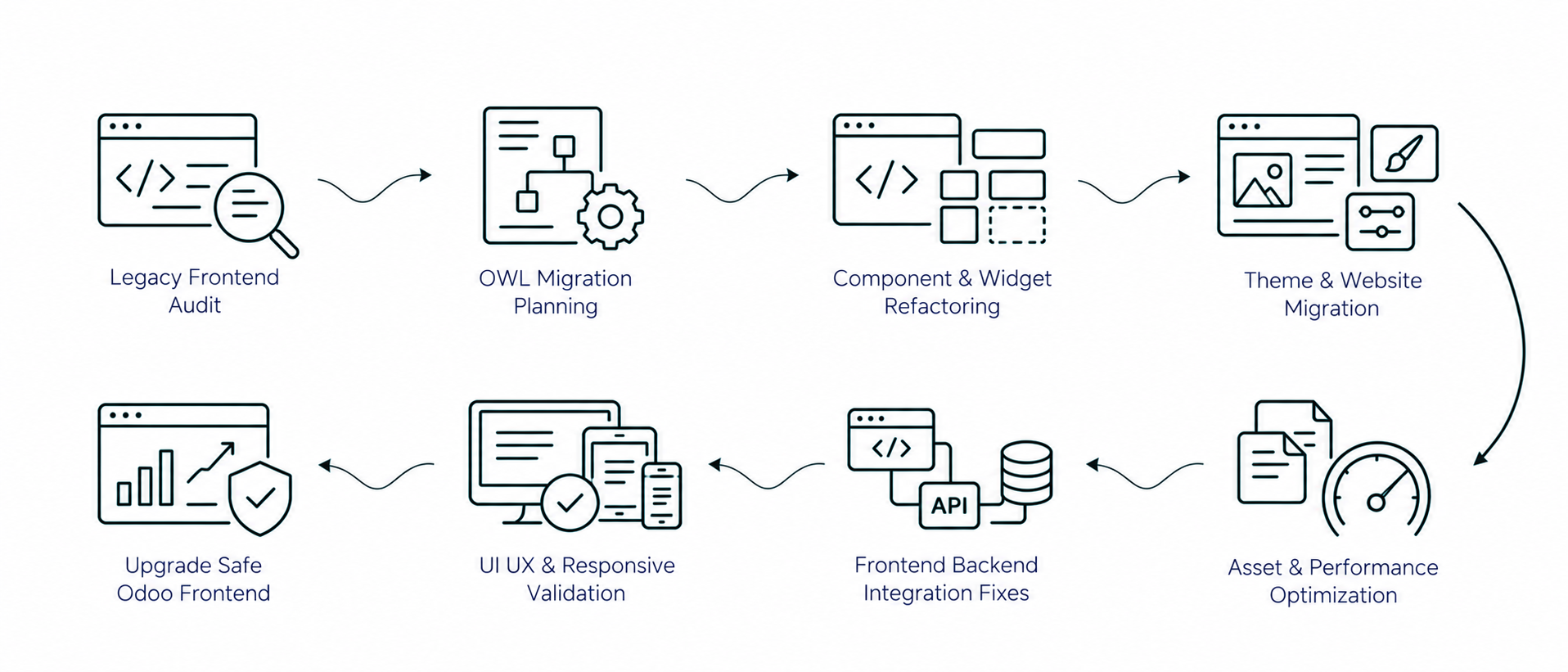
We perform frontend migrations using a stability-first and upgrade-safe approach. Our process includes OWL-based refactoring, asset optimization, theme migration, and UI improvements to ensure compatibility with modern Odoo versions while maintaining performance and usability.
How it connects
The complete workflow, in one view.
Make an informed decision
Is this the right fit?
The right solution starts with the right operating requirements.
Do you migrate from older versions like v14 or v15?
Yes, we handle migrations from older Odoo versions.
Is OWL migration mandatory in v17+?
Yes, OWL is the standard frontend framework.
Will custom modules keep working after migration?
Yes, we refactor them for compatibility.
Can you improve performance during migration?
Yes, performance optimization is part of the process.
How do you verify custom Odoo modules and website themes after migration?
We test the migrated frontend in a staging environment using agreed business workflows. Validation covers custom fields, forms, client actions, website pages, portal interactions and browser errors. Any remaining incompatibilities are documented before production deployment.
Start with your requirements
Let’s define your next step.
Tell us what needs to work better, the systems you use, and the scope you have in mind.