Launch a fitness and wellness app MVP with Django and Next.js. PySquad builds workout plans, tracking, coaching, and engagement features for health-focused products.
Results depend on scope, integrations and adoption.
The operating context
A clearer view of the whole operation.
Fitness and wellness products need more than workout content to keep users engaged. Onboarding, personalized plans, progress tracking, coaching, subscriptions, notifications, and feedback loops all influence whether users continue using the product after the first few sessions.
Where friction builds
Most fitness apps fail due to low engagement, not lack of features.
Many fitness apps lose relevance after signup because users receive generic plans with limited connection to their goals, progress, or routine. Founders often respond by adding more features, but additional complexity does not necessarily solve weak engagement or unclear product value.
Trying to launch workouts, nutrition, wearables, coaching, community, payments, and analytics together can also slow validation. A focused MVP should prove the core engagement loop first, then expand based on actual user behavior and product demand.
Current approach
Launch generic workout experiences
Overbuild the first MVP
Ignore onboarding and retention
Add integrations without validation
Operational impact
High user drop-off after initial signup
Low retention and poor habit formation
Limited insights into user behavior
Difficulty scaling engagement features later
Inside the solution
The capabilities behind the operation.
Review the functional scope, then discuss the requirements specific to your team.
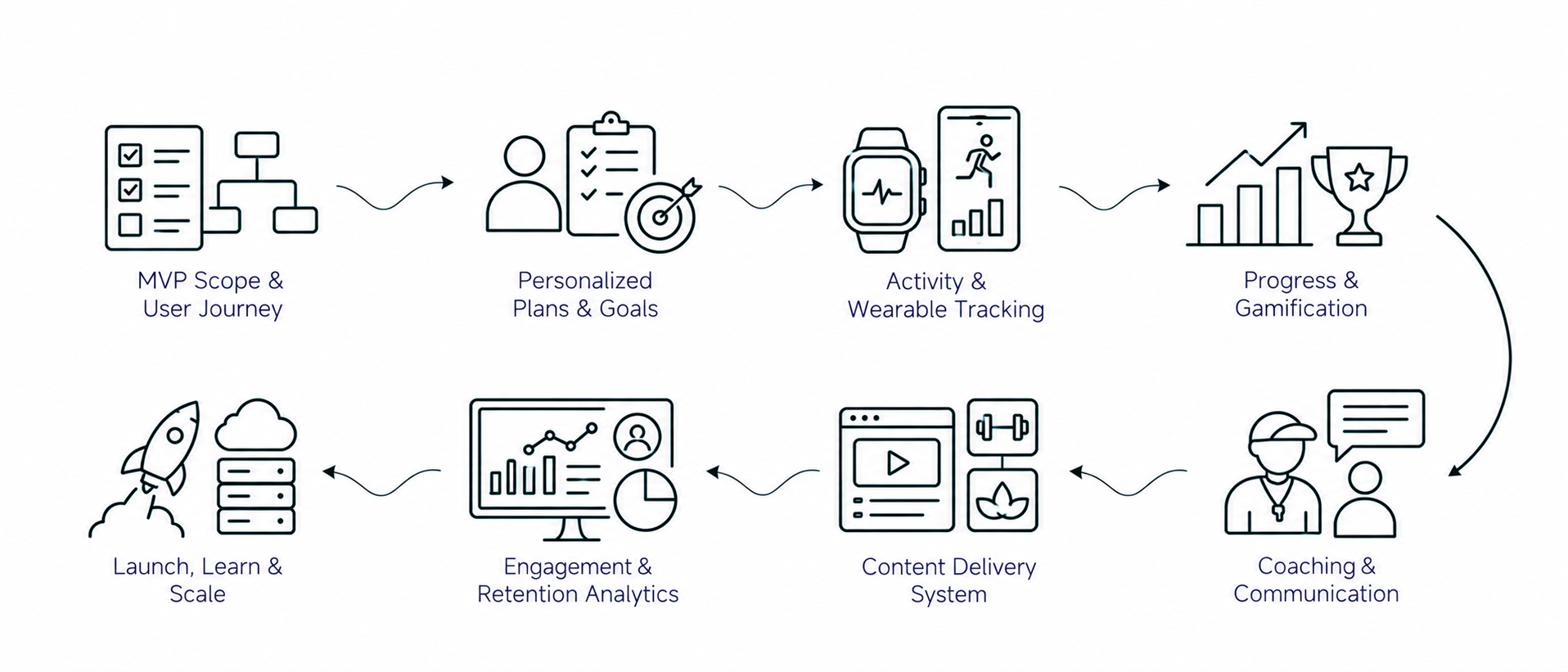
Personalized Plans & Goals
Create goal-based workout, nutrition, or habit plans tailored to each user.
Activity & Wearable Integration
Sync steps, heart rate, workouts, and biometrics from devices or manual inputs.
Progress & Gamification
Track streaks, achievements, and performance metrics to motivate users.
Coaching & Communication
Enable coaches to guide users with messaging, feedback, and content delivery.
Content Delivery System
Deliver workouts, videos, and wellness content in structured formats.
Analytics & Retention Insights
Measure engagement, churn, and user behavior to improve product decisions.
Define engagement-first MVP features and user journeys
02
Build API-first backend with Django for scalability
03
Develop fast, responsive frontend using Next.js
04
Implement tracking, analytics, and feedback loops
Our approach
We build fitness and wellness MVPs with a strong focus on engagement, personalization, and measurable outcomes. Using Django and Next.js, we create scalable, API-first platforms that support real-time tracking, coaching workflows, and data-driven product decisions.
How it connects
The complete workflow, in one view.
Make an informed decision
Is this the right fit?
The right solution starts with the right operating requirements.
Can a fitness app MVP integrate with Fitbit, Apple Health, or other wearables?
Yes. Wearable and health platform integrations can be added where the required APIs and permissions are available. The integration can support relevant activity, workout, and health data needed by the product.
Can coaches manage multiple clients through the fitness app?
Yes. A coach portal can provide client management, program assignment, progress review, communication, feedback, and content delivery capabilities based on the product requirements.
Can the MVP include workout videos and wellness content?
Yes. The platform can include structured workout plans, exercise instructions, video content, educational materials, and other wellness resources. Content can be delivered through the web application and connected to a suitable storage or CDN setup.
How can a fitness app measure engagement and retention?
The product can track metrics such as active users, workout completion, session frequency, goal progress, retention, churn, and other engagement events. These metrics can be used to understand which features and workflows encourage continued usage.
How long does it take to build a fitness or wellness app MVP?
The timeline depends on the number of user journeys, tracking requirements, wearable integrations, content workflows, and other MVP features. A focused first release can be delivered faster by prioritizing the core experience needed to validate user engagement and product demand.
Start with your requirements
Let’s define your next step.
Tell us what needs to work better, the systems you use, and the scope you have in mind.