Reduce employee time spent searching for information
Improve answer consistency across departments and teams
Lower operational dependency on key knowledge holders
Accelerate onboarding, support, and internal decision making
Results depend on scope, integrations and adoption.
The operating context
A clearer view of the whole operation.
Organizations store important knowledge across documents, wikis, tickets, databases, shared drives, and internal applications. When employees must search each system separately, finding reliable answers becomes slower and increasingly dependent on knowing where the information lives.
Where friction builds
Why internal knowledge becomes difficult to retrieve
Most businesses already have the information employees need, but it is fragmented across systems with different owners, formats, and permissions. Traditional keyword search often returns too many results, while generic AI assistants may answer without using the organization's current or approved information.
A useful internal knowledge agent must retrieve the right source, respect existing permissions, show where the answer came from, and stay aligned as documents change. Without those controls, RAG can make information easier to access while still creating trust, security, or freshness problems.
Current approach
Search across disconnected repositories
Maintain static internal FAQs
Ask experts repetitive questions
Use generic AI without grounding
Operational impact
Employees spend too long searching
Answers differ across teams
Knowledge stays dependent on experts
Unsupported AI answers create risk
Inside the solution
The capabilities behind the operation.
Review the functional scope, then discuss the requirements specific to your team.
RAG powered answer retrieval
Generate responses grounded in approved internal knowledge instead of unsupported AI outputs.
Secure multi source ingestion
Connect documents, databases, tickets, and internal tools into a unified knowledge layer.
Source cited responses
Help teams verify answers quickly with direct references to source materials.
Role based access controls
Ensure employees only access information permitted by organizational policies.
Continuous knowledge synchronization
Keep recommendations accurate by updating indexed content as information changes.
Cross platform agent access
Make knowledge available through web portals, Slack, Teams, and business applications.
Audit internal systems to identify high value knowledge sources
02
Structure documents and data for efficient retrieval performance
03
Build vector search pipelines optimized for business specific queries
04
Implement permission models aligned with organizational access policies
05
Test answer quality using real employee and operational questions
06
Deploy monitoring workflows that continuously improve retrieval accuracy
Our approach
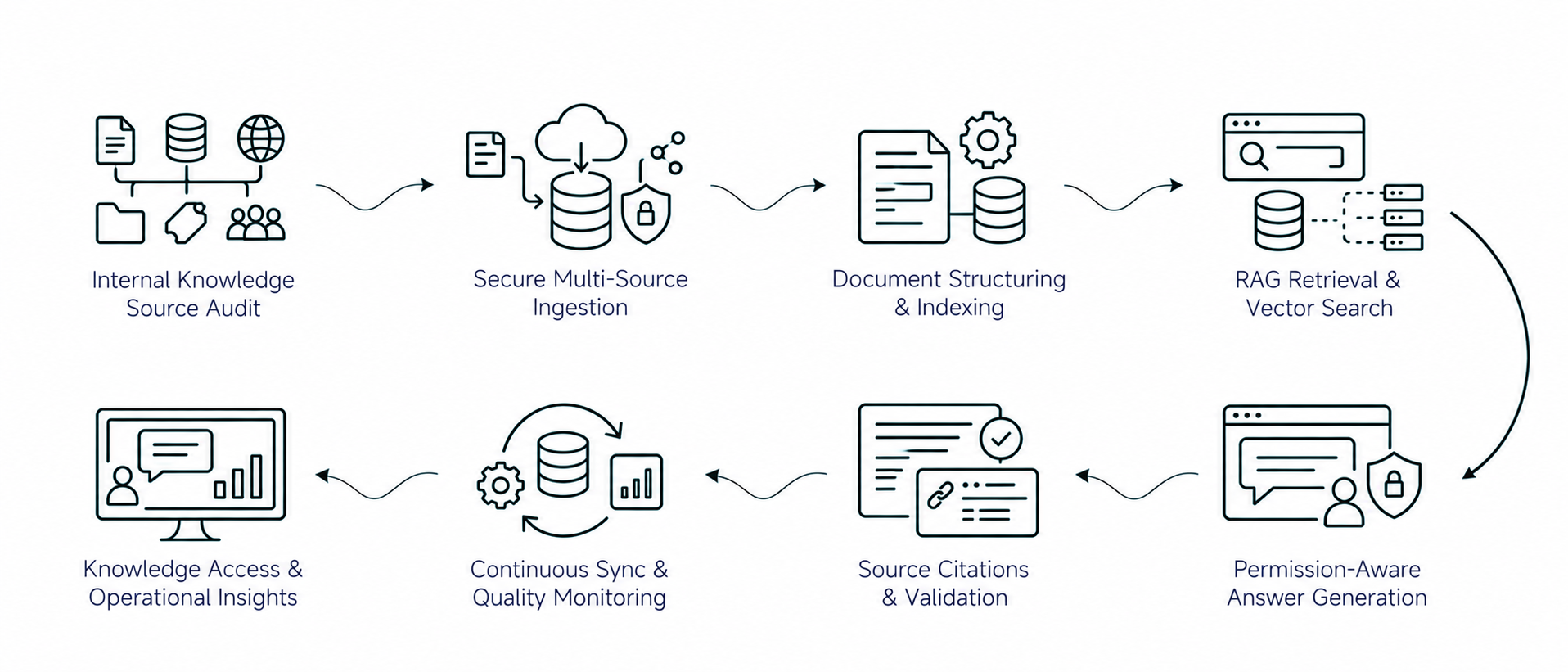
We first map your organization's knowledge sources and identify the information that creates the most operational value. We then build permission aware RAG pipelines that retrieve relevant content, generate source backed answers, and respect existing access rules. Answer quality is tested against real business questions, while monitoring and synchronization keep the knowledge layer useful as internal information changes.
How it connects
The complete workflow, in one view.
Make an informed decision
Is this the right fit?
The right solution starts with the right operating requirements.
An AI knowledge management agent uses Retrieval Augmented Generation to answer questions using your organization's internal documents, systems, and records. Unlike a standard chatbot, it retrieves relevant information before generating a response, which improves accuracy and provides source-backed answers employees can verify and trust.
How is a RAG knowledge agent different from ChatGPT alone?
A RAG solution connects directly to your approved internal data rather than relying primarily on general training information. This allows the agent to answer organization-specific questions, reference current documents, and provide source citations. It significantly reduces the risk of inaccurate responses when employees need operational or compliance-related information.
Can the knowledge agent connect to our existing business systems?
Yes. Most deployments integrate with document repositories, SharePoint, Google Drive, Confluence, Jira, Zendesk, databases, internal portals, and other business applications. PySquad designs data ingestion workflows around your existing technology stack so employees can access information without changing how teams work.
How do you protect sensitive company information?
Security is built into the architecture through role-based access controls, permission-aware retrieval, encryption, and audit logging. Employees only receive information they are authorized to access. For organizations with strict compliance requirements, we can support private cloud or on-premise deployments to maintain full control of internal data.
How long does it take to build an AI knowledge management system?
Most projects begin with data discovery, retrieval design, and pilot testing before moving into production deployment. Timeline depends on the number of systems, document volume, and security requirements. Many organizations can launch an initial RAG knowledge agent within a few weeks and expand coverage over time.
Start with your requirements
Let’s define your next step.
Tell us what needs to work better, the systems you use, and the scope you have in mind.