
In this article
Artificial Intelligence (AI) projects often demand high computational power and efficient distributed systems to manage workloads. Ray, an open-source framework, simplifies distributed computing and parallel processing for Python developers. This blog explores how Ray empowers AI applications with seamless scalability, provides a detailed Python code example, highlights its advantages, and discusses industries utilizing it. Learn how Nivalabs can assist in implementing Ray for your AI needs.
Why Ray for AI?
In the AI landscape, scalability, distributed execution, and parallelism are crucial to achieving efficiency. Ray addresses these challenges by:
- Scalability: Automatically scaling workloads across clusters.
- Ease of Use: Providing a simple API that integrates seamlessly with Python.
- Flexibility: Supporting diverse use cases like reinforcement learning, hyperparameter tuning, and model serving.
- Optimized Performance: Leveraging actors and tasks for distributed parallel processing.
Ray’s integration with popular AI libraries like TensorFlow, PyTorch, and Hugging Face makes it a preferred choice for building robust AI pipelines.
Ray with Python: Detailed Code Sample with Visualization
Use Case: Distributed Hyperparameter Tuning
This example demonstrates how Ray can distribute hyperparameter tuning across multiple workers.
pip install ray
import ray
from sklearn.datasets import load_iris
from sklearn.ensemble import RandomForestClassifier
from sklearn.model_selection import train_test_split
import numpy as np
import matplotlib.pyplot as plt

# Initialize Ray
ray.init()

# Load the Iris dataset
data = load_iris()
X_train, X_test, y_train, y_test = train_test_split(data.data, data.target, test_size=0.2, random_state=42)

# Train a simple model
model = RandomForestClassifier()
model.fit(X_train, y_train)

# Define a remote function for making predictions
@ray.remote
def make_prediction(model_bytes, data_chunk):
    import pickle
    # Deserialize the model
    model = pickle.loads(model_bytes)
    # Make predictions
    return model.predict(data_chunk)

# Serialize the model for distribution
import pickle
model_bytes = pickle.dumps(model)

# Split test data into chunks for parallel processing
data_chunks = np.array_split(X_test, 4)

# Use Ray to make predictions in parallel
predictions = ray.get([make_prediction.remote(model_bytes, chunk) for chunk in data_chunks])

# Combine predictions
final_predictions = np.concatenate(predictions)

# Evaluate the model
accuracy = np.mean(final_predictions == y_test)
print(f"Model Accuracy: {accuracy:.2f}")

# Visualization: Plot predictions vs actual labels
plt.figure(figsize=(10, 6))
plt.scatter(range(len(y_test)), y_test, color="blue", label="Actual Labels", marker="o")
plt.scatter(range(len(final_predictions)), final_predictions, color="red", label="Predicted Labels", marker="x")
plt.title("Actual vs Predicted Labels")
plt.xlabel("Sample Index")
plt.ylabel("Class")
plt.legend()
plt.grid(True)
plt.show()

# Shutdown Ray
ray.shutdown()
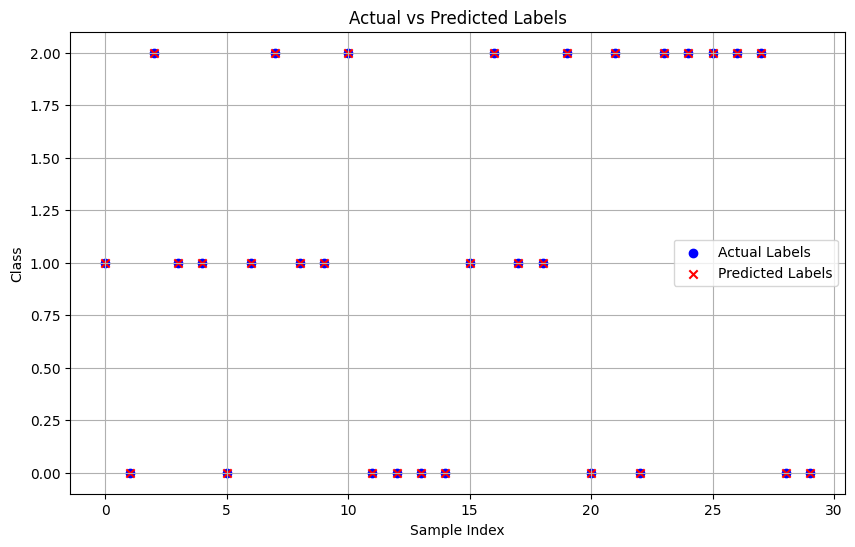
Model Accuracy: 1.00

Pros of Ray
- Simplified Scalability: Enables horizontal scaling without complex configurations.
- Comprehensive API: Supports tasks, actors, and pipelines for diverse use cases.
- Library Ecosystem: Includes Ray Tune, Ray Serve, and Ray RLib for specialized tasks.
- Cost-Effective: Optimizes resource utilization, reducing computational costs.
- Community Support: Active development and contributions from organizations like Anyscale.
Industries Using Ray
- Healthcare: For distributed training of predictive models and genome analysis.
- Finance: Fraud detection, algorithmic trading, and credit scoring pipelines.
- E-commerce: Recommendation systems and inventory optimization.
- Robotics: Reinforcement learning for real-world robot simulations.
- Autonomous Vehicles: Scalable simulations for route planning and decision-making.
How Nivalabs Can Assist in Implementation
At Nivalabs, we integrate cutting-edge technologies like Ray to enhance AI pipelines. Our services include:
- Custom AI Pipelines: Designing and implementing scalable solutions tailored to your business.
- Performance Optimization: Leveraging Ray for distributed training and inference.
- Consultation and Training: Guiding your team in adopting and mastering Ray.
- End-to-End Support: From integration to maintenance, ensuring seamless operation.
References
Conclusion
Ray revolutionizes AI development by enabling scalability and simplifying distributed computing. Its rich ecosystem and Python integration make it a game-changer for AI practitioners across industries—partner with Nivalabs to seamlessly implement Ray and unlock the full potential of your AI projects.