Results depend on scope, integrations and adoption.
The operating context
A clearer view of the whole operation.
D2C fashion brands manage fast-changing collections, thousands of SKU variants, seasonal demand, online channels, warehouses, returns, and production partners. When these workflows are spread across separate tools, stock accuracy and fulfillment performance become difficult to control.
Where friction builds
Fashion brands lose agility when inventory, production, and sales are not synchronized.
Fashion businesses often struggle to keep sizes, colors, styles, channel inventory, and warehouse stock synchronized. A product may appear available online while the actual variant is unavailable, creating overselling, cancellations, and customer service issues.
As order volumes and collections grow, procurement, subcontract production, fulfillment, returns, and exchanges create additional complexity. Without one connected system, teams cannot reliably understand stock availability, product performance, or the true operational cost of each collection.
Current approach
Manage channels in separate systems
Track variants through spreadsheets
Plan purchasing from historical reports
Handle returns outside ERP
Operational impact
Stock availability becomes unreliable
Variant inventory becomes difficult
Fulfillment delays increase
Returns reduce operational visibility
Inside the solution
The capabilities behind the operation.
Review the functional scope, then discuss the requirements specific to your team.
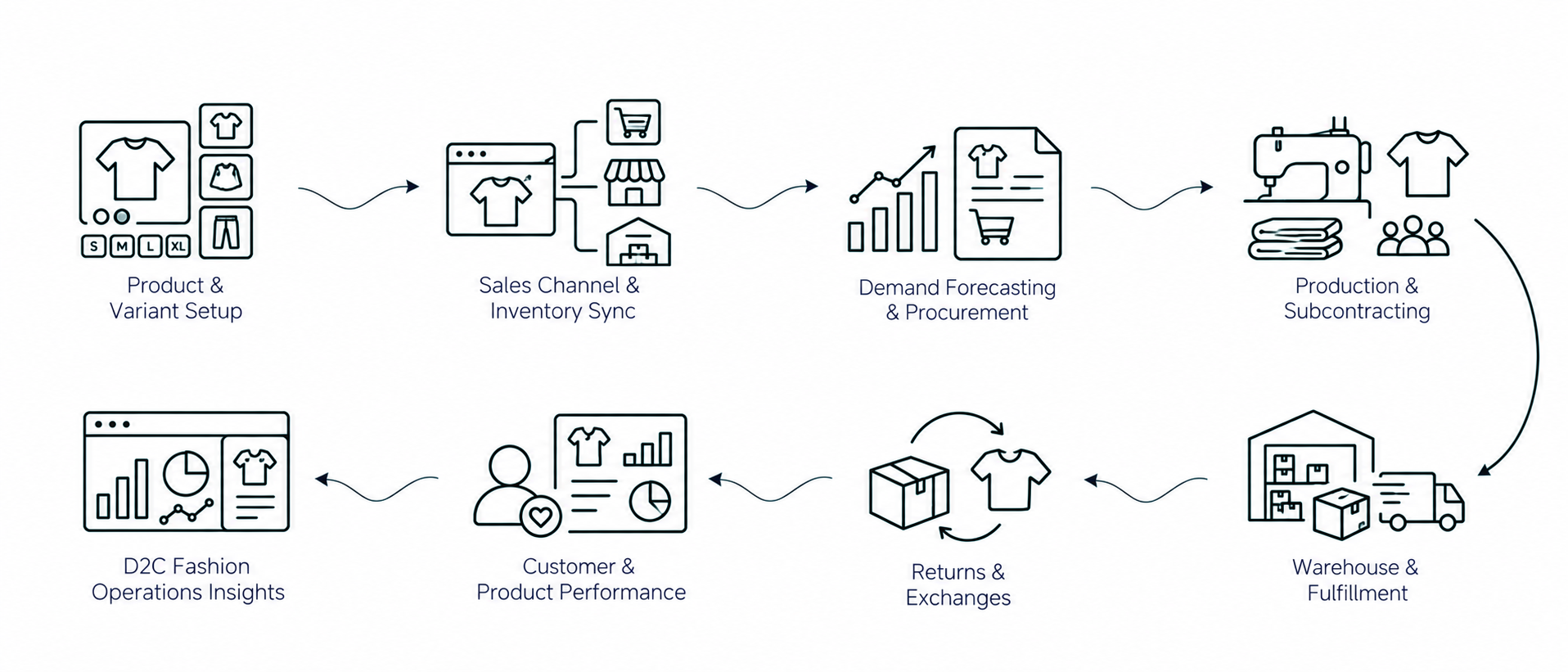
Product and Variant Management
Manage SKUs, sizes, colors, styles, and seasonal catalogs.
Multi-Channel Inventory Synchronization
Real-time stock updates across website, marketplaces, and warehouse.
Demand Forecasting and Procurement
Plan restocking and purchasing based on sales trends.
Production and Subcontracting Workflows
Manage in-house and outsourced manufacturing processes.
Warehouse and Fulfillment Automation
Optimize picking, packing, and order routing workflows.
Returns and Customer Experience Management
Handle returns, exchanges, and customer interactions efficiently.
We build Odoo-based ERP systems tailored for D2C fashion workflows. Our focus is on synchronizing product data, inventory, production, fulfillment, and customer insights into one system, enabling brands to operate efficiently and scale with confidence.
How it connects
The complete workflow, in one view.
Make an informed decision
Is this the right fit?
The right solution starts with the right operating requirements.
Can Odoo manage fashion products with multiple sizes and colors?
Yes. Odoo can manage product variants such as size, color, style, material, and other attributes under a structured product catalog. Each variant can have its own SKU, barcode, inventory level, pricing, and availability.
Can Odoo sync fashion inventory across Shopify, WooCommerce, and marketplaces?
Yes, when supported integrations or APIs are available. Inventory, orders, products, and fulfillment data can be synchronized between Odoo and ecommerce or marketplace channels. The synchronization frequency and supported data depend on the selected connector and implementation.
Can Odoo manage returns and exchanges for fashion orders?
Yes. Returns and exchanges can be linked with the original order, returned stock, refunds, replacement items, and return reasons. This is especially useful for fashion businesses where size and fit-related returns are common.
Can Odoo manage outsourced fashion manufacturing and subcontractors?
Yes. Odoo can support subcontract manufacturing workflows where external partners produce finished goods or complete specific production steps. Material supply, purchase orders, subcontracting, receipts, and production records can be connected within the ERP.
Can Odoo help forecast fashion inventory and replenishment?
Yes. Odoo can support replenishment using historical demand, stock levels, reorder rules, lead times, and configured planning methods. More advanced forecasting can also be added, but forecast accuracy depends on the quality of sales history, seasonality data, and planning inputs.
Start with your requirements
Let’s define your next step.
Tell us what needs to work better, the systems you use, and the scope you have in mind.