Results depend on scope, integrations and adoption.
The operating context
A clearer view of the whole operation.
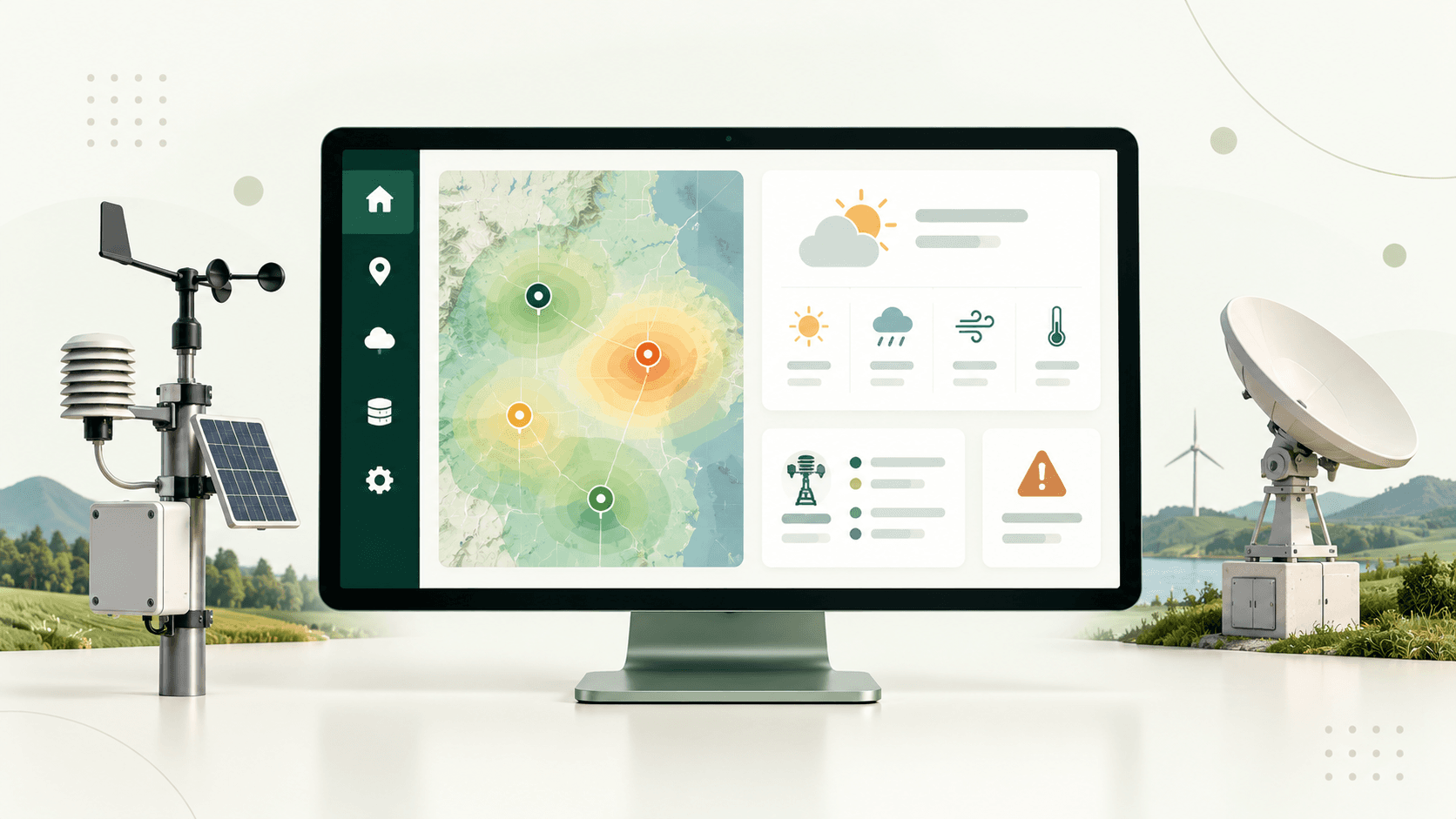
Accurate weather forecasting is critical for industries like agriculture, energy, logistics, and urban planning. However, standard forecasts often lack the resolution and precision needed for localized decision-making, especially in environments where microclimates vary significantly.
Where friction builds
Generic forecasts fail at local accuracy
Most organizations depend on broad weather APIs that do not capture local variations. This leads to inaccurate planning, missed risks, and inefficient operations. Without microclimate insights, teams cannot respond effectively to changing environmental conditions.
Current approach
Rely on generic weather APIs
Ignore local sensor data
Use one model everywhere
Interpret forecasts manually
Operational impact
Local conditions remain underrepresented
Forecast uncertainty gets overlooked
Operational decisions use coarse data
Site-specific risks surface too late
Inside the solution
The capabilities behind the operation.
Review the functional scope, then discuss the requirements specific to your team.
Microclimate modelling
Generate hyper-local forecasts using geospatial clustering techniques
Multi-source data integration
Combine satellite, IoT, radar, and historical climate datasets
AI forecasting models
Predict temperature, wind, rainfall, and other parameters with ML
Geospatial visualization
Display weather layers, heatmaps, and localized insights
Continuous model retraining
Improve accuracy over time with updated data
Alerts and APIs
Provide real-time alerts and integration for operational systems
Collect and integrate environmental and sensor data
02
Design geospatial and machine learning models
03
Build forecasting engines and visualization tools
04
Continuously optimize models for accuracy and scale
Our approach
We build AI-powered forecasting platforms that combine multiple data sources and machine learning models to generate accurate, hyper-local predictions. Our systems are designed to adapt continuously and provide actionable insights.
How it connects
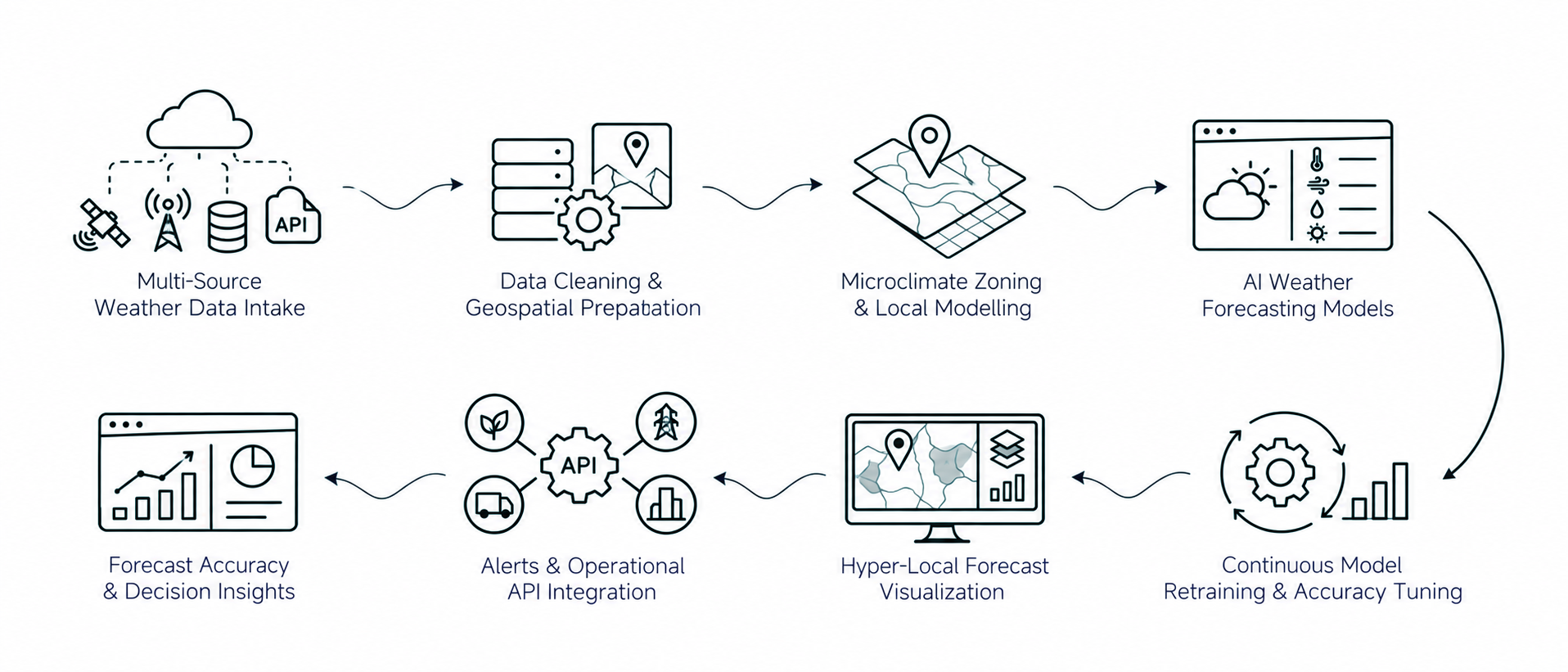
The complete workflow, in one view.
Make an informed decision
Is this the right fit?
The right solution starts with the right operating requirements.
Hyperlocal weather forecasting produces predictions for a much smaller geographic area than standard regional forecasts. It can combine broader forecast models with local sensors, terrain, land-use, and historical observations to better represent conditions at a specific site or operating area.
How are AI models used in weather forecasting?
Machine learning models can learn relationships between historical weather states and future conditions, support downscaling, accelerate forecast generation, or produce probabilistic forecasts. In operational forecasting, AI is increasingly used alongside established numerical weather prediction methods rather than simply replacing them.
What data is needed to build a microclimate forecasting model?
Useful inputs can include weather station observations, satellite data, radar, IoT sensors, terrain, elevation, historical weather records, and larger-scale forecast data. The exact mix depends on the location, target variable, forecast horizon, and required spatial resolution.
How accurate are hyperlocal weather forecasts?
There is no single accuracy level that applies everywhere. Forecast skill depends on the weather variable, lead time, terrain, sensor quality, model design, and local data coverage. A production system should be evaluated using validation metrics for each location and forecast horizon rather than relying on a blanket accuracy claim.
Can microclimate forecasts be integrated into existing business systems?
Yes. Forecasts can be exposed through APIs or event-driven alerts and integrated with farm management, energy operations, logistics, smart-city, or planning systems. The integration can trigger actions based on thresholds such as rainfall risk, high wind, heat, or other configured conditions.
Start with your requirements
Let’s define your next step.
Tell us what needs to work better, the systems you use, and the scope you have in mind.