Agentic AI development services in the USA to build autonomous workflow automation systems using AI agents, LLM orchestration, and secure business integrations.
Results depend on scope, integrations and adoption.
The operating context
A clearer view of the whole operation.
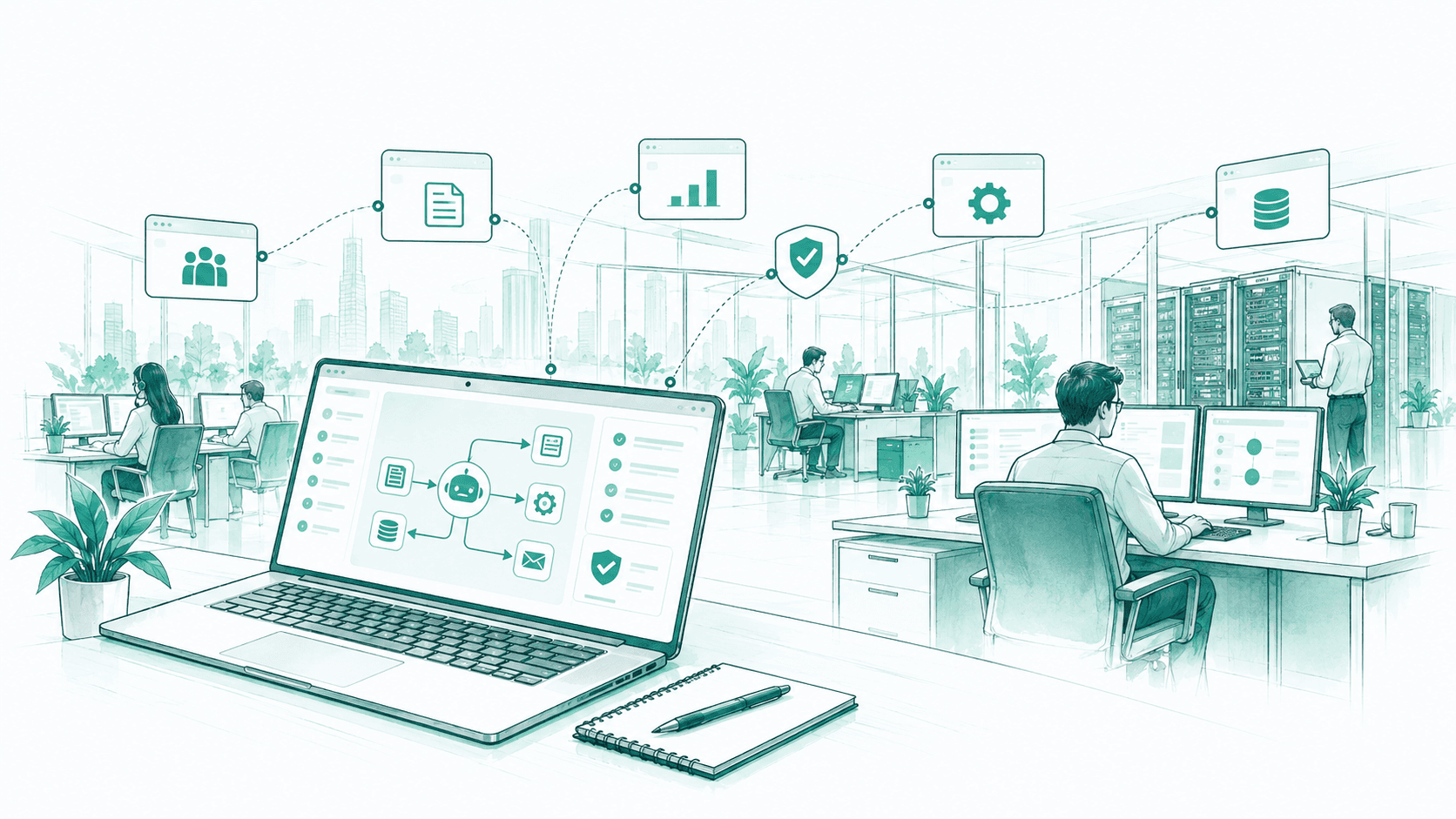
US businesses are adopting AI agents that can execute tasks across CRM, ERP, support, and internal systems. Production deployment requires defined permissions, reliable tool execution, human approvals, and monitoring. PySquad builds agentic AI systems around these controls to automate multi-step business workflows.
Where friction builds
Why autonomous AI agents fail in production
Most teams experiment with agent frameworks without defining workflow boundaries, escalation paths, or monitoring systems. Agents loop unpredictably, misuse tools, expose data, or generate inconsistent results. What appears autonomous in demos becomes risky in real operations.
Current approach
Deploy agent frameworks without workflow modeling
Grant broad system access to AI agents
Skip guardrails and escalation design
Ignore evaluation and monitoring in production
Operational impact
Unpredictable or looping agent behavior
Security and data access risks
Operational disruption from incorrect actions
Low trust in autonomous systems
Inside the solution
The capabilities behind the operation.
Review the functional scope, then discuss the requirements specific to your team.
Agent Architecture and Orchestration Design
Structured agent workflows with defined tools, memory, and decision boundaries.
Workflow Automation Integration
Connect AI agents to CRM, ERP, support, and internal systems securely.
Guardrails and Permission Controls
Role-based access, action limits, and escalation paths for safe automation.
Monitoring and Evaluation Frameworks
Track agent performance, accuracy, cost, and behavior in production.
Scalable Infrastructure for Agent Systems
Production-ready deployment optimized for reliability and cost control.
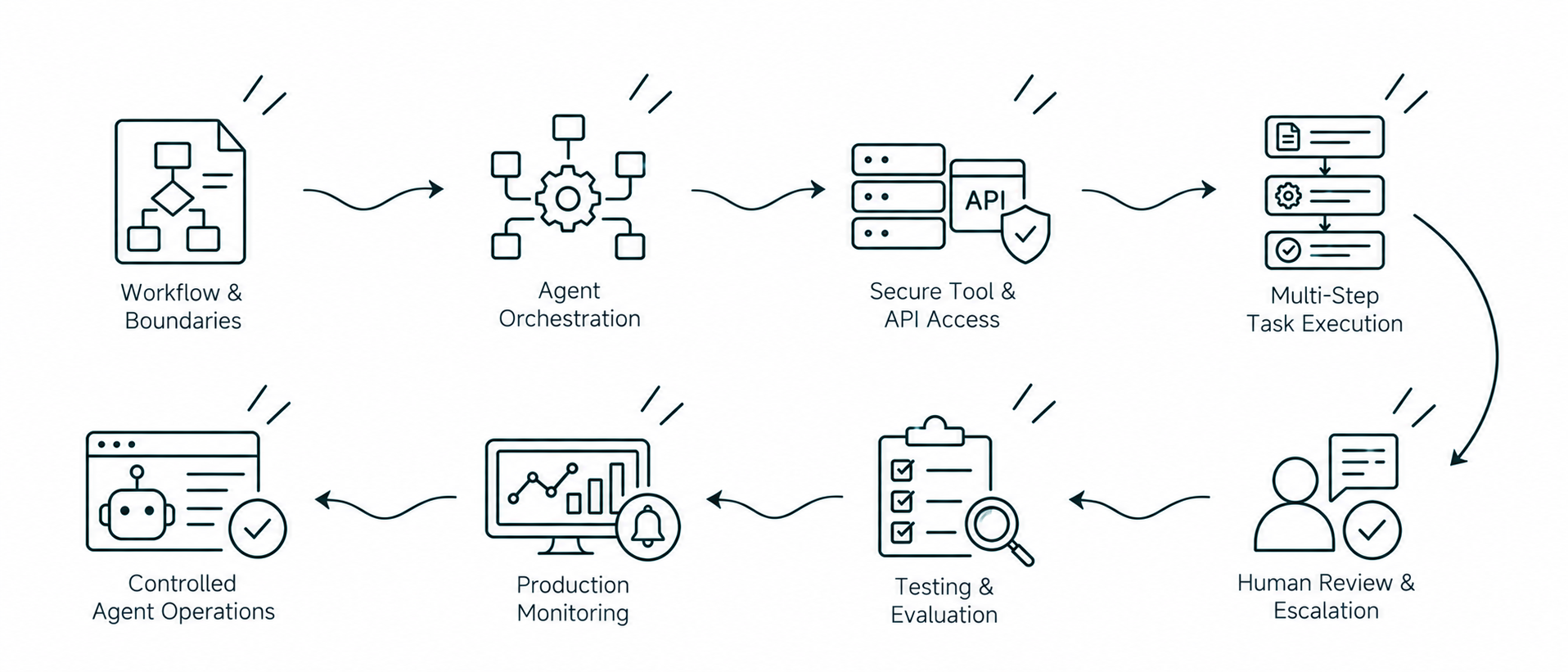
Start with clearly defined workflows and boundaries
02
Design tool access with least-privilege principles
03
Test agents in controlled environments before scale
04
Continuously monitor and refine agent behavior
Our approach
We build agentic systems as controlled orchestration layers. Tools, memory, permissions, and decision logic are clearly defined so agents operate within safe, auditable constraints.
How it connects
The complete workflow, in one view.
Make an informed decision
Is this the right fit?
The right solution starts with the right operating requirements.
What is agentic AI compared to standard LLM integration?
Agentic AI systems can plan, decide, and execute multi-step workflows using tools and memory, rather than only generating responses.
Can agents interact with our internal systems securely?
Yes. We implement role-based permissions, secure APIs, and strict access controls to protect sensitive systems.
How do you prevent agents from making harmful decisions?
Through guardrails, bounded tool access, human-in-the-loop escalation, and continuous monitoring.
Is this suitable for enterprise automation?
Absolutely. Agentic systems are especially powerful for structured internal workflows like support triage, document processing, or operational coordination.
How long does it take to deploy a production-ready AI agent?
Focused agent workflows can typically be deployed within a few months, depending on system integrations and workflow complexity.
Start with your requirements
Let’s define your next step.
Tell us what needs to work better, the systems you use, and the scope you have in mind.