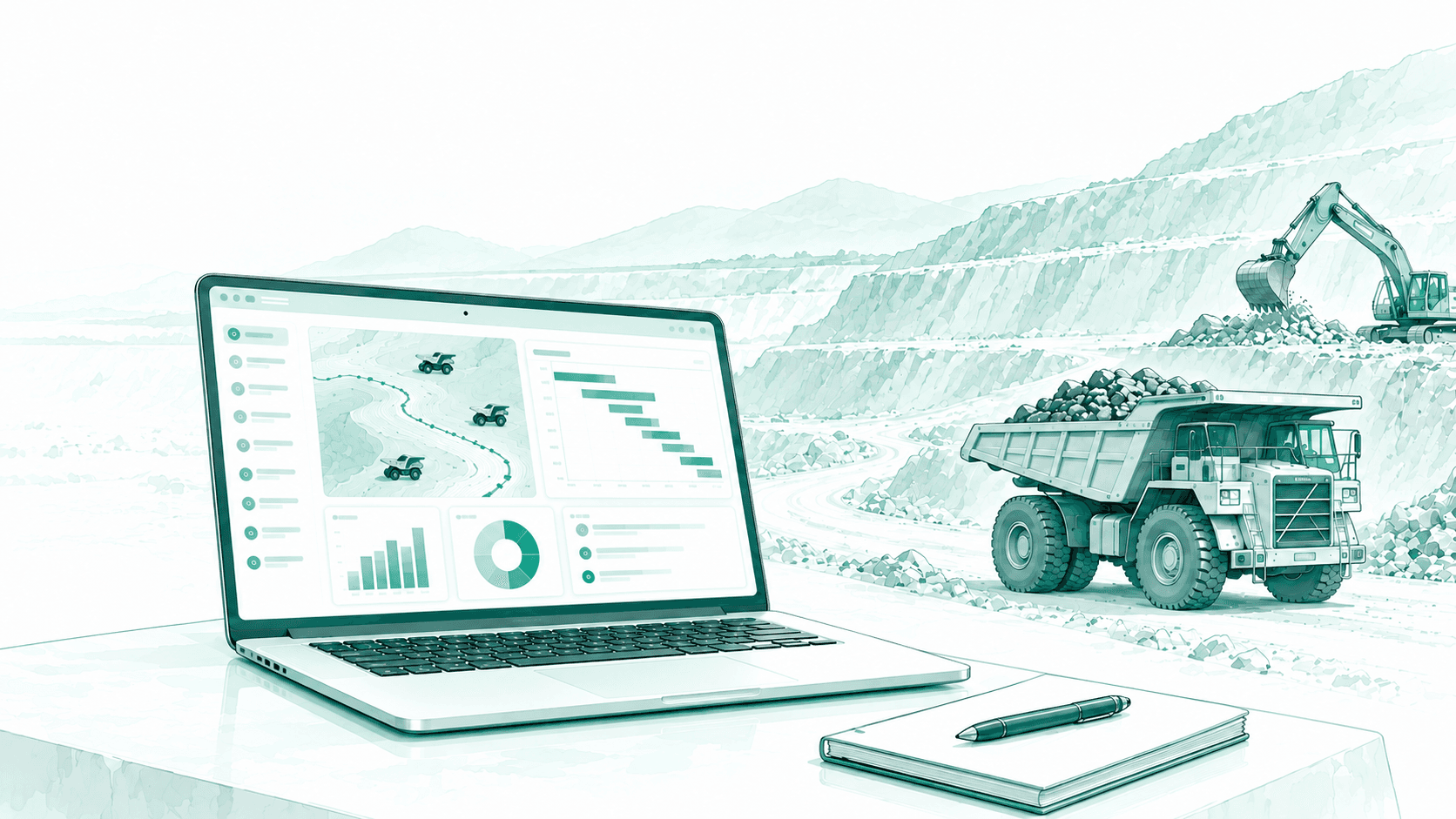
Plan mine production, short-term schedules, constraints, equipment, and plan-vs-actual tracking with software that connects mine planning to ERP execution.
Results depend on scope, integrations and adoption.
The operating context
A clearer view of the whole operation.
Mine planning only works when schedules reflect real equipment, workforce, maintenance, haulage, and geological constraints. Connecting long-term planning, short-term scheduling, and daily execution helps mining teams respond faster when site conditions change.
Where friction builds
Mine plans fail when they are disconnected from execution
Many mining organizations invest heavily in strategic planning but still struggle to achieve forecast production outcomes. Mine schedules are often developed separately from operational realities, leaving critical constraints such as fleet availability, maintenance windows, drill-and-blast dependencies, workforce coverage, ore blending requirements, and material movement limitations insufficiently addressed. When unexpected events occur, planners rely on spreadsheets and manual updates that slow decision-making and create inconsistent schedules. Teams lack visibility into plan-versus-actual performance, production variances, schedule adherence, and root causes of underperformance. As a result, production targets are repeatedly adjusted instead of consistently achieved.
Current approach
Separate long-term and short-term mine plans
Build production schedules in spreadsheets
Replan reactively after operational disruptions
Run planning and operations in disconnected systems
Operational impact
Schedules become unrealistic as conditions change
Production targets are repeatedly missed
Manual rescheduling consumes planner time
Operational bottlenecks remain difficult to identify
Inside the solution
The capabilities behind the operation.
Review the functional scope, then discuss the requirements specific to your team.
Production planning and targets
Create production plans by pit, phase, bench, stope, zone, asset, or mining area with feasibility validation against operational capacity, production goals, grade requirements, and business objectives.
Short-term scheduling
Generate shift, daily, weekly, and rolling schedules with equipment assignment, crew allocation, task sequencing, production priorities, and operational dependency management.
Constraint and dependency management
Model fleet availability, maintenance schedules, workforce constraints, drill-and-blast activities, haulage capacity, material flow limits, stockpile requirements, ore blending rules, and operational dependencies.
Plan versus actual tracking
Monitor production performance in real time using operational data to identify schedule deviations, production variances, bottlenecks, and corrective actions before targets are missed.
Continuous replanning support
Enable rapid scenario analysis and schedule optimization when conditions change, allowing planners to evaluate alternatives and maintain achievable production commitments.
Production dashboards and reporting
Deliver role-based dashboards, KPI tracking, forecasting, variance analysis, and management reporting for planners, supervisors, operations teams, and executives.
Map end-to-end mine planning, scheduling, dispatch, and execution workflows
02
Model operational, geological, maintenance, workforce, and logistics constraints directly within scheduling logic
03
Integrate fleet management, maintenance, ERP, production, and operational data sources
04
Build schedule optimization capabilities that support realistic production outcomes
05
Provide plan-versus-actual visibility with actionable operational insights
06
Design intuitive tools that planners, engineers, supervisors, and managers adopt as part of daily operations
Our approach
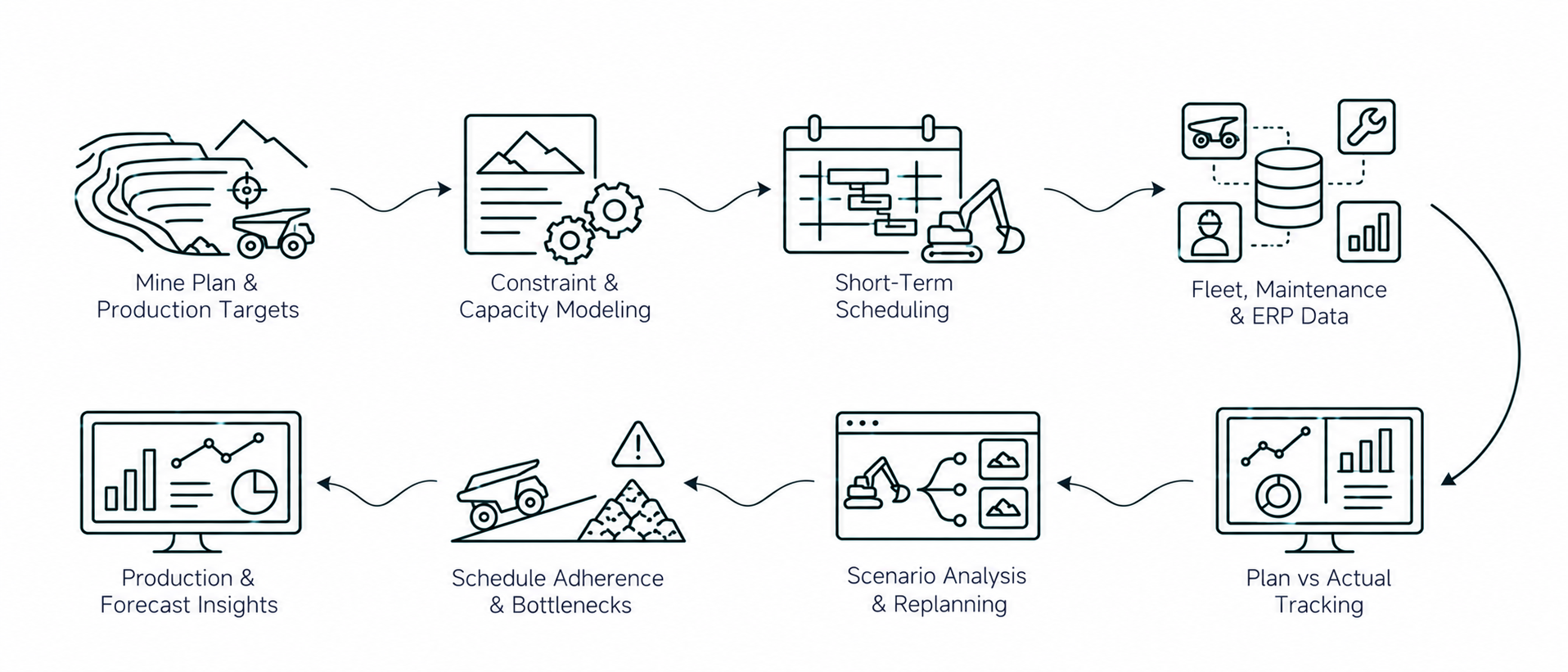
We build mine production scheduling platforms that connect long-term planning, medium-term forecasting, short-term scheduling, and daily operational execution into a single decision-support environment. By integrating real production data, operational constraints, and schedule optimization logic, mining teams gain the visibility and agility needed to maintain production targets, improve resource utilization, and respond rapidly to changing site conditions.
How it connects
The complete workflow, in one view.
Make an informed decision
Is this the right fit?
The right solution starts with the right operating requirements.
Mine production scheduling software helps mining companies plan, schedule, and optimize production activities based on equipment availability, workforce capacity, maintenance schedules, and operational constraints. It improves schedule accuracy, production visibility, and target achievement across open-pit and underground mines.
Is this suitable for both open-pit and underground mines?
Yes. The platform supports both open-pit and underground mining operations. Planning and scheduling models can be configured around site-specific workflows, production methods, development activities, equipment fleets, material movement requirements, and operational constraints.
Can schedules adapt to equipment downtime?
Yes. The system supports constraint-aware replanning and schedule optimization. Equipment downtime, maintenance events, workforce shortages, haulage disruptions, and other operational changes can be incorporated quickly so planners can generate updated schedules and maintain production objectives.
Does this integrate with fleet and maintenance systems?
Yes. The solution is designed for integration with fleet management systems, maintenance platforms, ERP solutions, dispatch systems, production databases, and other operational technologies to ensure planning decisions are based on current site data.
Can this support multi-site planning?
Yes. Multi-site mining organizations can manage production planning, scheduling, performance monitoring, and reporting across multiple operations while maintaining site-level visibility and consolidated operational oversight.
Start with your requirements
Let’s define your next step.
Tell us what needs to work better, the systems you use, and the scope you have in mind.