Best Predictive Analytics Solutions for Enterprises
Predictive analytics solutions for enterprises to forecast demand, identify risks, improve planning accuracy, and support data-driven decisions across operations, finance, and strategy.
Results depend on scope, integrations and adoption.
The operating context
A clearer view of the whole operation.
Enterprises generate large volumes of operational, financial, customer, and market data, but most planning still depends heavily on historical reporting. Predictive analytics becomes useful when that data is turned into forward-looking signals that directly support business decisions.
Where friction builds
Prediction fails when insights are disconnected from real decisions.
Forecasting often fails because models are built separately from the decisions they are supposed to support. Historical averages, static assumptions, and siloed datasets can produce predictions that become less useful as business conditions change.
Even technically strong models create little value when users cannot understand them or when predictions remain trapped in dashboards. Enterprises need measurable, explainable predictions that can be monitored over time and delivered directly into planning and operational workflows.
Current approach
Spreadsheet-based forecasting models
Static predictions updated infrequently
Siloed data used in isolation
Predictions delivered only as standalone reports
Operational impact
Low forecasting accuracy in changing conditions
Limited trust in predictive outputs
Slow response to emerging risks or opportunities
Minimal influence on actual business decisions
Inside the solution
The capabilities behind the operation.
Review the functional scope, then discuss the requirements specific to your team.
Demand and volume forecasting
Accurate forecasting across products, regions, and time horizons using structured data inputs.
Risk and anomaly prediction
Early identification of operational, financial, and supply chain risks before they escalate.
Scenario and what-if analysis
Evaluate potential outcomes under different assumptions to support planning decisions.
Explainable prediction models
Transparent models that show key drivers, confidence levels, and reasoning behind outputs.
Model monitoring and improvement
Continuous tracking, validation, and retraining to manage performance and drift.
Enterprise system integration
API-first integration with ERP, planning, and analytics systems for seamless adoption.
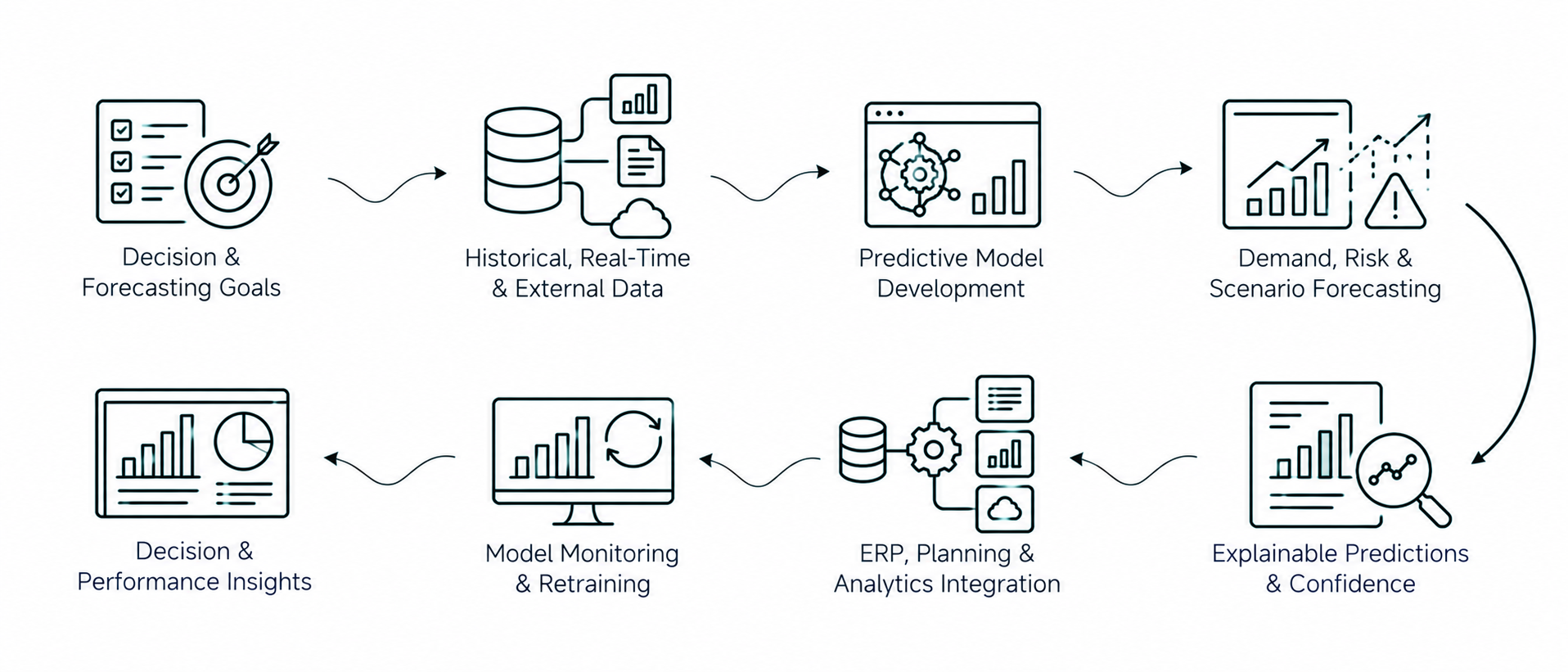
Start with the decisions predictions need to support
02
Combine historical, real-time, and external data sources
03
Design explainable and measurable predictive models
04
Embed predictions directly into operational workflows
Our approach
We build predictive analytics systems with decision-making as the central focus. This means starting from the business questions that matter and designing models around them. We combine structured data pipelines with explainable modeling techniques so predictions are both accurate and understandable. Our systems are designed to integrate directly into enterprise workflows, ensuring outputs are not isolated but actively used.
How it connects
The complete workflow, in one view.
Make an informed decision
Is this the right fit?
The right solution starts with the right operating requirements.
What types of data are required for predictive analytics?
Predictive analytics can use historical data, real-time operational data, and selected external data sources. We typically start with the data you already have and assess what additional signals can improve accuracy.
Are the prediction models explainable to business users?
Yes. We prioritise explainable models so operations, finance, and leadership teams understand why a prediction was made and how confident it is, not just the output.
Can predictive analytics integrate with existing ERP or planning systems?
Yes. Our solutions are API-first and designed to integrate with ERP, planning, and analytics tools so predictions appear directly in existing workflows.
How often are predictive models updated or retrained?
Models are monitored continuously and retrained based on data changes, performance drift, or business needs. Update frequency is defined based on the use case and data volatility.
Is this suitable for both short-term forecasting and long-term planning?
Yes. The same platform can support short-term operational forecasts as well as longer-term strategic planning and scenario analysis.
Start with your requirements
Let’s define your next step.
Tell us what needs to work better, the systems you use, and the scope you have in mind.