
On this page
Somebody signed up for your product last night at 11:40pm.
They came in from a comparison article, read your pricing page twice, and created an account. Then they landed inside the product, looked at an empty dashboard, clicked two things, could not figure out how to connect the one integration they actually came for, and closed the tab.
They will not email you. They will not open a ticket. They will not answer your day-three onboarding email, because they never got far enough to care. In your analytics they are a signup. In reality they were a customer for about ninety seconds.
That person is the most expensive thing in SaaS, and almost nobody builds for them.
The 8 percent problem
ChartMogul's SaaS Conversion Report, published in January 2026 from a survey of 200 B2B software products, found the median free-to-paid conversion rate sits at 8 percent.
Read that as the sentence it actually is: for a typical product, 92 out of every 100 people who sign up never become customers.
The report is worth sitting with because it also shows how wide the spread is. Around 20 percent of free trial products convert below 2.5 percent. Another 23 percent convert above 25 percent. Same market, same year, roughly a tenfold difference in outcome. The gap between those two groups is not usually the product. Both groups built something decent. The gap is what happens in the first twenty minutes.
The trial structure matters too. ChartMogul put trials without a credit card at good being 4 to 6 percent and great being 10 to 15 percent, while trials that ask for a card upfront land at good being 25 to 35 percent. That difference is mostly about intent, not persuasion. People who hand over a card have already decided to try properly.
Which means if you run a no-card trial, and most product-led companies do, you are inviting a large group of half-curious people in and then betting your growth on whether they figure things out alone.
On churn the industry numbers are messier and I would be careful with any that sound too precise, because they vary wildly between reports. But the direction is consistent everywhere: the bulk of SaaS churn happens early, in the first weeks and months, not gradually over years. People do not leave because the product got worse. They leave because it never started working for them.
Documentation is not onboarding
Here is the thing most SaaS teams do when signups are not converting. They write more docs.
More help articles, a longer knowledge base, a video library, a better tooltip tour. All useful. None of it solves the actual problem, because documentation answers questions in the order you organized them, and a confused new user has a question in the order they hit it.
Think about what that person at 11:40pm actually needed. Not a docs site. Not a fifteen minute walkthrough video. They needed to ask one specific question, in their own words, at the moment they got stuck, and get an answer in about six seconds.
That gap between having a question and finding the answer is where trials die. Every extra step you put in it, opening a new tab, searching a help centre, guessing the right keyword, scanning an article that turns out to be about something adjacent, loses a percentage of people. Not because they are impatient, but because trying your product was already a low-commitment experiment for them, and friction is the thing that makes low-commitment experiments end.
The other reason docs lose is that they cannot see context. A help article does not know the user is on day one, on the free plan, with no data imported yet. It gives the same answer to everyone.
The cancel screen, and the conversation nobody is having
Now flip to the other end of the lifecycle.
A paying customer clicks cancel. What happens at most SaaS companies is a dropdown with five reasons, a textarea nobody fills, and a confirmation button. It is the single highest-intent moment in the entire customer relationship, and it gets treated as a form submission.
Consider how much you would pay for a conversation with that person right now. You are getting one for free and throwing it away.
Some of those cancellations are genuinely done, and you should let them go cleanly. But a real share of them are not churn at all, they are unresolved problems wearing a churn costume. Somebody on the wrong plan paying for capacity they never use. Somebody who hit a limitation that a feature shipped three months ago actually solved. Somebody whose annual renewal came at an awkward moment for their budget and who would happily move to monthly. Somebody who never got the one integration working, which brings us right back to onboarding.
None of those people need a retention discount. They need someone to ask one good question. And they are almost always cancelling at a time when nobody on your team is online.
Where NIVA fits for a SaaS team
This is the shape of problem NIVA is built for, and it is worth being specific rather than saying "AI helps."
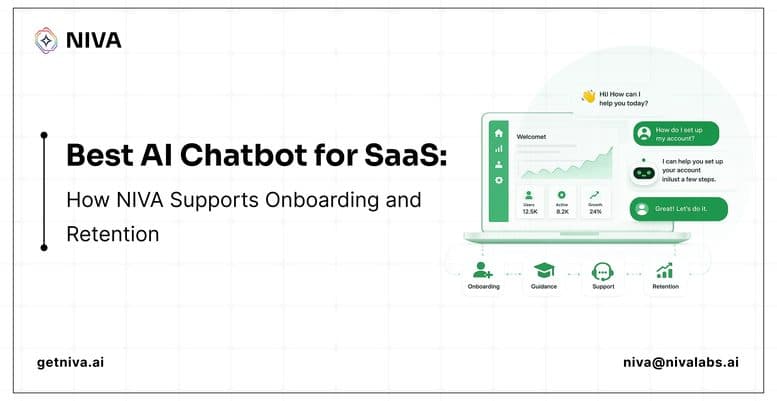
On the onboarding side. A product onboarding assistant sits inside the experience and answers the stuck-at-11:40pm question in the user's own words, instead of sending them to search a help centre. That matters most in exactly the hours your team is asleep, which for a global SaaS product is most of them.
Because it works from your own product content, it answers about your product rather than improvising something generic that sounds plausible and wastes the user's time. And it starts from a knowledgeable position rather than a blank one, since NIVA ships with over 250 pre-built industry personas so you are shaping an assistant that already understands SaaS conversations rather than teaching one what a trial is.
On the getting-things-done side. Answers alone do not activate anybody. The reason that user left was an unfinished task, not an unanswered question. NIVA's no-code Flow Engine walks someone through a real multi-step setup to completion, and the Smart Form Engine collects what you need conversationally rather than presenting a wall of fields to a person who has known you for four minutes.
On the retention side. This is where it gets interesting. A churn deflection assistant turns that dead cancel form into an actual conversation, at 2am, in the moment, when the reason is still fresh and fixable. Alongside it, a renewal and retention assistant handles the renewal conversation before it becomes a surprise, and a proactive conversion and retention agent reaches out during a trial rather than waiting to be asked. For subscription businesses generally, the same pattern covers subscription support questions about plans, billing and access.
On not making it one bot doing everything. A trial user, a paying admin, and someone in the cancel flow are three completely different conversations, and one generic assistant handling all three does all three badly. NIVA's multi-persona setup lets onboarding, support, billing and sales each run their own persona, with routing between them handled automatically. Your sales side can also run lead qualification through the same platform rather than buying a second tool for it.
On fitting your existing stack. Signals go where your team already works, with connections to systems like HubSpot, Zendesk and Freshdesk, so a churn risk or a qualified trial lands in your CRM rather than a dashboard nobody checks. Your team gets pulled in through Slack, live handover picks up the moments that genuinely need a human, and anything specific to your product connects through a custom API. The full channel list covers wherever else your users turn up.
On the questions your prospects will ask you. If you sell software to other companies, your own buyers send security questionnaires, and NIVA publishes its security and trust documentation openly rather than making you chase it during someone else's procurement cycle.
Two numbers, one lever
Most SaaS teams treat onboarding and churn as separate projects owned by separate people. Growth owns activation. Customer Success owns retention. Different dashboards, different meetings, different quarterly goals.
They are the same problem seen from two ends. A user who never reached value in week one is the customer who cancels in month four. The cancel reason and the abandoned trial are usually the same sentence, just delivered later and more expensively.
Which is why one assistant working both ends is worth more than two tools working one each. It is the same conversation, and it is the conversation your team is not currently in the room for.
What to actually do with this
Pick one moment and look at it honestly. The last twenty people who abandoned during setup, or the last twenty who cancelled. Read what they did, not what they told you.
If most of them ran into something answerable, you do not have a product problem or a pricing problem. You have a nobody-was-there problem, and that one is fixable this month rather than next roadmap cycle.
Wondering how many of your 92 are actually recoverable? See what an onboarding and retention assistant looks like for your product at NIVA, or talk it through with us if you would rather start with your own numbers. If cost is the open question, what AI chatbots really cost in 2026 lays it out plainly.
Source: ChartMogul SaaS Conversion Report, January 2026, based on a survey of 200 B2B software products.