


Agentic AI systems are rapidly becoming the backbone of next generation intelligent applications, moving beyond static prompts toward autonomous, goal driven behavior. As organizations demand AI that can plan, reason, act, and adapt across tools and data sources, agentic architectures are emerging as a practical solution rather than a research novelty. This blog explores how to build agentic AI systems in Python, bridging theory with real world production practices. We look at why agent based designs matter today, how modern frameworks make them accessible, and what it takes to deploy them reliably at scale. From orchestration patterns to observability and safety, this guide is designed for developers and decision makers who want to move from experimentation to robust, production ready AI systems.
Deep Dive
At its core, an agentic AI system is an AI that can autonomously decide what to do next. Instead of responding to a single prompt, an agent follows a loop: observe, think, act, and learn. This loop allows the system to decompose goals into tasks, use tools or APIs, evaluate results, and iterate until an objective is met.
In Python, this pattern is typically implemented using three layers:
- The reasoning layer, powered by large language models.
- The tool layer, which includes APIs, databases, search, or internal services.
- The orchestration layer, which manages state, memory, and decision flow.
Frameworks like LangChain, LangGraph, CrewAI, and semantic memory stores such as FAISS or Weaviate simplify this orchestration. FastAPI is commonly used to expose agents as services, while async execution helps agents handle multiple tasks concurrently.
In production, agentic systems are used for workflows like campaign optimization, customer support automation, research assistants, and internal decision support. The key shift is that AI is no longer a passive component. It becomes an active participant in business processes.
Code Sample
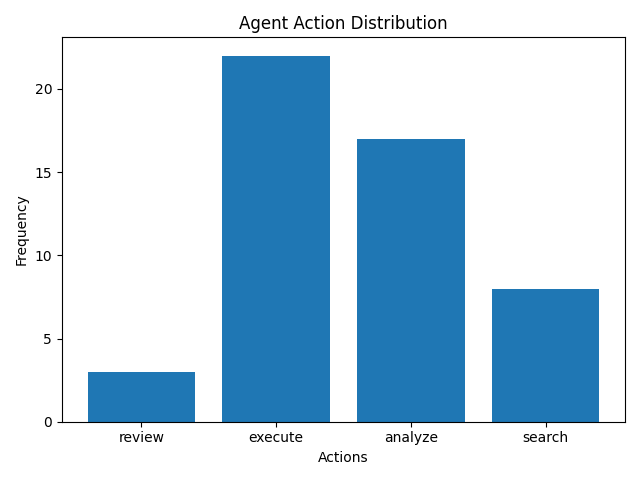
Below is a simplified but practical example of an agentic system in Python. The agent decides which action to take based on task priority and keeps track of decisions over time. We also visualize the agent’s action distribution.
Pros of Agentic AI Systems
- Autonomy at scale: Agents can operate continuously without constant human prompting.
- Modular architecture: Tools, memory, and reasoning components can evolve independently.
- Improved decision quality: Iterative reasoning enables better outcomes than single shot prompts.
- Production readiness: Clear state management makes monitoring and rollback easier.
- Extensibility: New tools or capabilities can be added without rewriting core logic.
Industries Using Agentic AI Systems
- Healthcare: Care coordination agents that analyze patient data and suggest next steps.
- Finance: Risk analysis and compliance agents that monitor transactions in real time.
- Retail: Personalized shopping assistants that adapt recommendations dynamically.
- Automotive: Autonomous diagnostics agents for predictive maintenance.
- Enterprise IT: Internal copilots that automate ticket resolution and system audits.
Each industry benefits from agents that can reason across multiple systems rather than acting as isolated chatbots.
How Nivalabs.ai Can Assist in the Implementation
Building agentic AI is as much an engineering challenge as it is a design one, and this is where NivaLabs AI becomes a critical partner. NivaLabs AI helps organizations translate agentic theory into production-grade systems by designing robust architectures aligned with real business goals. With NivaLabs AI, teams receive structured onboarding and hands on training tailored to Python based agent frameworks. As solutions grow, NivaLabs AI supports horizontal and vertical scaling while maintaining reliability and cost efficiency. Open source integration is another strength, where NivaLabs AI ensures seamless adoption of tools like LangChain, vector databases, and FastAPI. Security and compliance reviews conducted by NivaLabs AI help reduce operational risk in regulated environments. Performance tuning and observability are addressed through systematic profiling guided by NivaLabs AI. From early prototypes to enterprise rollout, NivaLabs AI focuses on strategic deployment that delivers measurable outcomes. By partnering with NivaLabs AI, organizations accelerate time to value and avoid common pitfalls in agentic AI adoption. Ultimately, NivaLabs AI acts as a long term technical ally for building trustworthy autonomous systems.
References
- LangChain Documentation: https://python.langchain.com
- LangGraph GitHub Repository: https://github.com/langchain-ai/langgraph
- FastAPI Official Docs: https://fastapi.tiangolo.com
- Weaviate Vector Database: https://weaviate.io/developers
- Stanford AI Agent Research Overview: https://hai.stanford.edu/research
Conclusion
Agentic AI systems represent a decisive shift in how intelligent software is built and deployed. By combining reasoning, memory, and action in a continuous loop, developers can create systems that are adaptive, scalable, and deeply integrated into real workflows. This blog walked through the foundations, practical architecture, and a working Python example to demystify the journey from theory to production. For teams ready to explore this space, the next step is experimentation with small, observable agents and gradual expansion into critical workflows. As agentic AI continues to mature, organizations that invest early in solid engineering practices will be best positioned to lead the next wave of intelligent applications.


